Antibiblioteca
“I brought Julia Child, Mastering The Art of French Cooking, which is a very necessary book”- Colman Domingo. And there it went, the french cookbook was dropped into a glass vault on display during Valentino's Spring/Summer 2027 collection.

Image Courtesy: Pinerest
Creative Director Alessandro Michele transformed Paris’s historic Bibliothèque Sainte-Geneviève into a runway, crafted around a dying literary space— the library. Alongside the Emmy award winning playwright, guests such as Cynthia Erivo, who brought Giovanni's Room, Lorenzo Zurzolo, who brought Ragazzi di vita by Pier Paolo Pasolini, were all included in this interactive art installation/fashion showcase.
When I first came across this event I got a weird knot in my stomach. I thought, this feels so dystopian, but I couldn’t nail down my reasoning? I did some digging around because I figured surely the concept had to involve more than “the value of unread books.”
To further elaborate, the box full of classic and niche literary titles showcases what we don't know as a symbol for endless curiosity and a sort of limitless “creative fuel.”
After even more research, I discovered the anthropological scene backing this event up and settled back into my seat a little bit. Attendees were asked to bring a book that would eventually be donated to local Parisian public libraries, making the show a literal exchange of knowledge. Still I can’t shake the uneasy feeling that this entire display was a bit ironic.
There was a very powerful essay that covers this phenomenon to which I have been utterly consumed with as of late. The essay is titled, “The End of Reading Is Here,” by Rose Horowitch. If you are subscribed to the Atlantic and get the chance to check it out, I highly recommend it!
That being said, Horowitch essentially argues that American society is entering what he considers a “postliterate era.” This era is characterized by the very complex systemic decline in the art of sustained, deep reading. This shift is primarily driven by the age of digital distraction and shorter attention spans, which we are all too familiar with. Over time, it comes to no one’s surprise that the long term effects threaten cognitive stamina and ultimately risks reverting society toward a more reactive, oral-dominant culture.
The essay tracks major statistics following recorded capacities to read and critically think in primary education. Sadly, this was even conducted on elite college institutions and came back with similar trends.
The essay most strikingly caught my attention as Horowitch points to a rather uncommon theory about the beloved Library of Alexandria. She interrogates the historical narrative of the Library, arguing that the place could have actually succumbed to a much more depressing fate, one as simple as mundane negligence.
During the time period where the Library would have existed, the actual work of maintaining the scrolls was found to be incredibly expensive, and society simply lost the collective will to care for them. And while we all have come to accept that its disappearance was due to the destructive acts of war, such as Julius Caesar’s siege or the torch under religious mobs, it could have simply been that over time the city simply lost the desire to preserve it. As in, the people abandoned the need for that amount of knowledge.
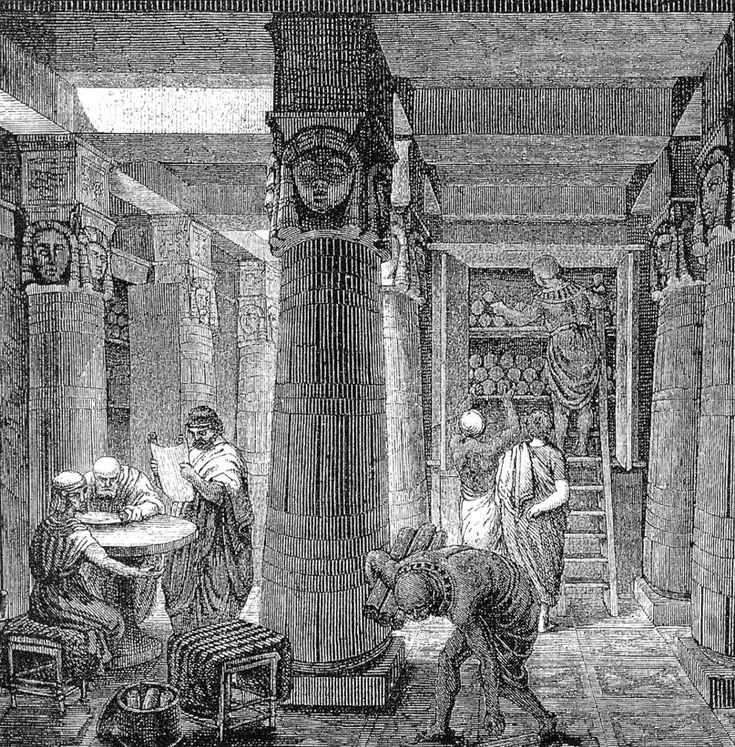
Image Courtesy: Pinterest
You can see how my anxiety grew after having read this article and seeing what appeared to be the new reality unfold right in front of me. Our current departure from a deeper understanding of literature and the world isn't happening because books are being banned or burned like they are painted in headlines or at the forefront of our minds. It could very well be that like ancient Alexandria, we are actively choosing an indifference.
I couldn't help but think, no one is going to go to those Parisian libraries. And as classicist Roger Bagnall points out, the library’s decay didn’t trigger a cultural dark age from the past; its abandonment was just proof that the dark age had already begun.
With all of this being said, I can not not discuss the new wave of performance. In a culture constantly plagued by systemic work overload and debilitating attention spans, deep reading has transitioned from what used to be a basic leisure activity into the ultimate luxury status symbol. Today, celebrities and influencers frequently engage in this performative reading. I preface this by stating that even though these people might actually be reading, that is not the point.
The main idea around performative reading I think just ties to larger issues surrounding the pentapagon and the notion that we feel the need to display our inner experience such as reading and having thoughts, to a platform where other people can in turn validate that experience. I even have further theories as to why we are entering a "postliterate" society but I fear I can not introduce the impacts of New Criticism to the conversation just yet.
In a world too exhausted to actually take the time to read, the appearance of intellect is a luxury only the wealthy can afford.
Treating heavyweight classics as posh accessories, only there to be photographed and understood on a secondary text basis has birthed a bizarre market for hyper-expensive, designer "classic titles on fashion." This obviously calls to Valentino but does not stop there. We have already seen it with brands such as Coach with their “"Express Your Story" campaign and Dior, with their “literature-inspired Book Tote.” Luxury houses and boutique publishers now bind public-domain literature in logo-embellished covers that are retailing for hundreds of dollars. Even on smaller scales, local boutiques have even caught up.

Image Courtesy: Pinterest
All in all, It is easy to look at a French cookbook being trapped in a Valentino glass vault and consider only the aestheticization of a dying medium. That is my own issue. But perhaps there is a much more generous way to read this emerging phenomenon. If the systemic burnout of modern life, inflation, and stress has transformed the love of deep reading into a luxury, then the fashion industry’s obsession with it is proving something vital. The greater message could possibly be that the written word still holds an immense, undeniable social currency. Even if the wave begins as a performance, any attention paid to reading is good attention.
By elevating the “classics” to an object of luxury or desire, we are seeing the early foundations of what could be a cultural counter-movement. Across major cities, this "couture literacy" is slowly introducing a genuine craving for real-world connections. The movement is even giving rise to new, physical reading “salons,”online book clubs, and independent curation spaces. These emerging environments might even be one step closer to reclaiming the concept of a solid, real "third space" outside of work and home.
We don't necessarily have to accept doom and repeat the tragedy of the Alexandrian negligence. If society is looking for a way back into to deep focus and critical thinking, these curated spaces offer a sanctuary to slow down. The real luxury of reading is that it is free! Reading doesn't have to belong exclusively to the wealthy, and we see this especially through the new wave of social movements to improve reading accessibility.
So if Alessandro Michele's runway taught us anything, it’s that literature will always have the capacity to spark curiosity and critical thought; it is up to us to actually practice what we preach and take the time out of our day to attempt to reclaim knowledge for our own sake. Ensure new reading spaces become crowded, it will do the world some good.
Strike out,
Selah Eve
Editor: Kaya O’Rourke
Saint Augustine
Selah is a content writer for Strike Magazine St. Augustine. Her name, Selah, meaning “pause and reflect,” and Eve, meaning “life,” reflects how she spends her time. She is a passionate student who loves to travel and meet new people. Check out her Instagram: @selah.eve and her Substack: @selaheve