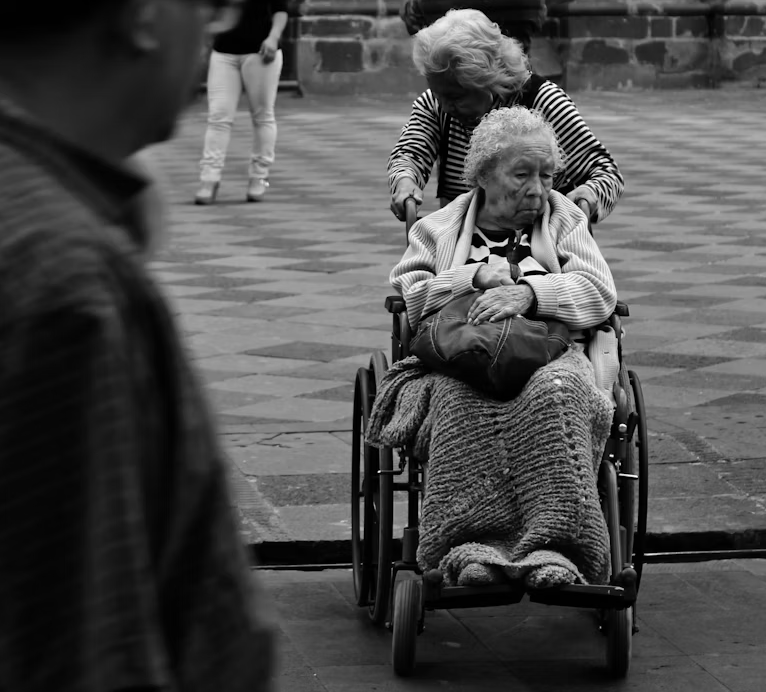
‘unknown person riding on wheelchair outdoors’ by Lara Lone | Unsplash
Empathy isn’t kindness–it’s power. It starts from caring about your neighbors to being vulnerable by sharing emotional experiences. Empathy drives us to take action for the things we truly care about, even issues that don’t affect us personally. This sentiment is seen as “soft” and “weak.” Empathy is more than a sentiment. It is a powerful weapon for action and connection worldwide. It all just depends on who’s holding it. Empathy’s leverage is frequently exploited by those in power, and more often than not, those who wish to have power.
People in power employ empathy as much as they do force. With force, there’s resistance, therefore, they turn to empathy. Empathy encourages the public, lowering the guard of individuals, framing control as care. Values are often turned against an ordinary person in ways that benefit the authority figure, causing further division. People with strong morals continue to be victims of this tactic and it is time that we resist.
Through politics, conflict, and war, empathy is weaponized. World War I displayed propaganda posters showing starving children and wounded soldiers, with the text that read , “Fight for Your Country.” On the surface, this is a patriotic message to Americans, intended to inspire men to join the military. Its true colors show a far more sinister message: “If you do not support war, you are a traitor to the American people.” The sacrifice of citizens is framed as a necessary compassion for the future of the country. Those against this idea were established as selfish and traitors to the U.S.
Later, in World War II–empathy or lack thereof, was the most prominent issue that turned a blind eye towards genocide. “Evil, I think, is the absence of empathy,” said Captain G. Gilbert, an Army Psychologist assigned during the Nuremberg Trials, a trial held against war criminals of Nazi Germany after their defeat in World War II. Ignorance and tolerance is why we see so many social issues and wars go on for long periods of time. Without taking time to understand the past, society tolerates dehumanization of current issues such as mass deportations and on-going genocides.
Empathy is a stepping stone to produce change within our society. Bringing our feelings to action by helping others, speaking for what is right, and even practicing self-empathy can contribute more than we can imagine. Implementing empathy into our societal structure by not just acknowledging the ongoing harm within our system, but reducing it and if possible, eliminating it as a whole.
“The only thing necessary for the triumph of evil is that good men do nothing,” said Edmund Burke, a 1700s Anglo-Irish writer. Ironically, Burke is known as the father of conservatism. He condemned those who partook in the French Revolution, claiming it was on a destructive path. Although this quote is a critique, it takes on a different meaning today. Like the French, we partake in change, rejecting traditional values. Embracing empathy is a sign of rebellion, signaling that the people hold the power to change. The lack of empathy from the public is what has made our social-economic status worse. If a genuine incapacity to feel and understand each other connected the defendants of Nazi Germany, then the capacity to empathize with current issues can unify us.
Social media has desensitized the public, minimizing serious political issues that should enrage the average person. Online, we have witnessed a variety of videos–from playful satire to content that shows tragedies happening across the country. Through the internet, we have watched people become victims of violence, we have seen hate speech, and those who govern us to abuse their power–all without consequence. Although we witness these horrible tragedies occurring on our devices, we choose to consume and not react. A world without empathy fueling our anger, is a world where we keep our oppressors in control. Without empathy, we enable harmful leadership. We are manipulated into cooperation without compensation, and self-serve authoritarian powers.
Empathy is not something that should be an overbearing burden, instead it should be an instrument we collectively use for the greater good. Empathy is a weapon that every person carries. A weapon that brings the truth to light, used for the greater good.
Strike Out,
Helen Capote
Miami
Helen Capote is a studying Social Work and Journalism at Florida International University. Helen’s work analyzes sociology and modern culture. Her writing has been featured in Strike Miami’s Issue 09, HerCampus, PantherNOW, and self-publishes on substack. Besides writing, she pursues her passion for advocacy and indulges in her love for music.