A24’s Eternity, directed by David Freyne and starring Miles Teller, Elizabeth Olsen, and Callum Turner, stands out not only for its heartfelt exploration of love, memory, and soulmates, but also for its visual warmth brought to life through the masterful color work of David Tomiak. Beyond its sentimental monologues, character epiphanies, and deeply touching performances, what truly renders Eternity impossible to look away from is its striking, deliberate use of color.
David Tomiak, co-founder of Elemental Post in Vancouver, BC, played a key role in shaping the film’s emotional tone. Strike LA writer Andrea Arguello had the opportunity to speak with him about his work on Eternity.

Joan, played by Elizabeth Olsen, and Larry, played by Miles Teller, in Eternity.
Image courtesy of A24
AA: Hello Mr. Tomiak! First, I wanted to say how exciting it is to see a film in theaters with such intentional and striking color work, especially after a period in which so many films have felt visually muted and lacking in vibrancy. To begin this interview, I’d like to ask what initially drew you to becoming a colorist and working in film post-production?
DT: I have been coloring for 14 years now, but initially I wanted to be a cinematographer when I started film school. After graduating, I transitioned into color grading after seeing the power of what digital color grading could do, especially coming out of film school without a large budget. I started coloring music videos and fell in love with how color grading could warp images, which ultimately made me better at cinematography. I later broke both my arms in a bicycle accident and could not film anymore, so I taught myself how to color grade out of necessity; and then fell in love with it. I think the power of color grading is that it is such an intimate process. You work closely with the cinematographer, director, and producers to focus on making the project beautiful. I love the people aspect just as much as the technical side. What initially seemed to be two years of recovery turned into a full career in color grading.
AA: What do you consider to be the most challenging aspect of color grading?
DT: The most challenging part is maneuvering my way into the filmmaker's head to make sure that my work is authentic to what they are trying to say. The best way to do so is by advocating to be brought in during pre-production which does not happen all the time for colorists, as we are usually not brought in until the post-production process. The first time meeting a new team is challenging because you are all trying to work towards one vision for the film amongst many ideas. Once you start finding the vision and jumping off one another's ideas, you truly begin to find the heart of the film
AA: For Eternity, were you working with people you had previously worked with before, or was it a completely new team? How did this project land on your lap?
DT: It was a totally new team. To land the project, I prepared by studying their look books and watching the 1960s film references they shared to better understand and align with the team’s visual style. When the team visited us at Elemental, I felt a real momentum not just from the research, but from the passion I had for the script which helped me win the project.
AA: After reading the script, how did you strive to use color to reinforce the emotional core and themes of the film?
DT: When I read the script, I knew there was room for a lot of color, but it was not until I sat down with the director of photography, Ruairí O’Brien, and the director and writer, David Freyne, and fleshed out the ideas that I was able to see whether my ideas matched theirs. The team’s vision aligned with many of my natural tendencies, such as finding rich skin tones and playing with color and texture to enhance a beautifully emotional and visually striking film.
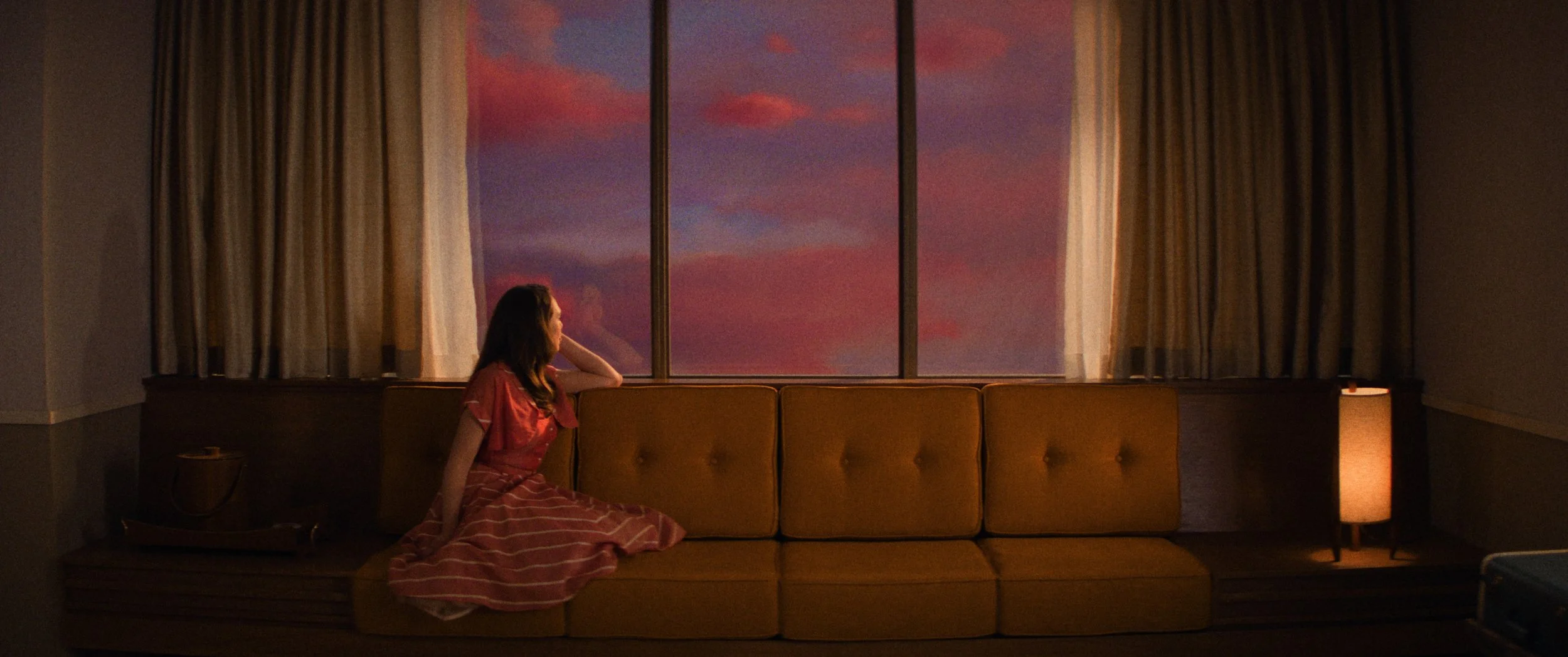
Joan, played by Elizabeth Olsen in Eternity
Image Courtesy of A24
AA: Were there any colors that you and the team intentionally chose to avoid or mute?
DT: No, I would not say there were any colors we wanted to mute. We just really wanted to make sure nothing had a tint to it, but instead had a pleasant vibrancy. We made sure there was a warm feeling, but did not tint too warm or too nostalgic. That way, each color could pop individually and also play off the lighting, enhancing texture and making sure elements stood out separately.
AA: One of my favorite parts of the film is the color grading of the memory tunnel. The scene is especially moving, with a warm, romantic tone, and it reminded me of the vibrant use of color in one of my favorite films La La Land. Going off of that, are there any films that have inspired your work or that you find yourself returning to often?
DT:There are a few different ones. All the films that the team and I were referencing were shot on film in the 1960s, so once we figured out what Kodak stock was used to shoot those films, we went down a rabbit hole and found other films that were shot on it. There were films such as The Sound of Music, The Good, the Bad and the Ugly, and 2001: A Space Odyssey, all of which were shot on it as well.
AA: Building off my favorite moment in the film, I was wondering is there a specific scene you are most proud of or consider your favorite?
DT: Emotionally, that last scene in the movie always gets me. When the music comes in, it’s warm and the skin tones look beautiful. But I think my favorite scene, though, is when Joan (Elizabeth Olsen) and Karen (Olga Merediz) are getting drunk together, and then it cuts to Larry and Luke (Miles Teller and Callum Turner) drinking at the same time.
It is so fun seeing the transition between the dark bar scene to the brightly lit booths. Also, there are some frames of Joan when she’s wearing the crown in the spaceship booth, which just look so unbelievable. That whole sequence, to me, is one of my favorites.
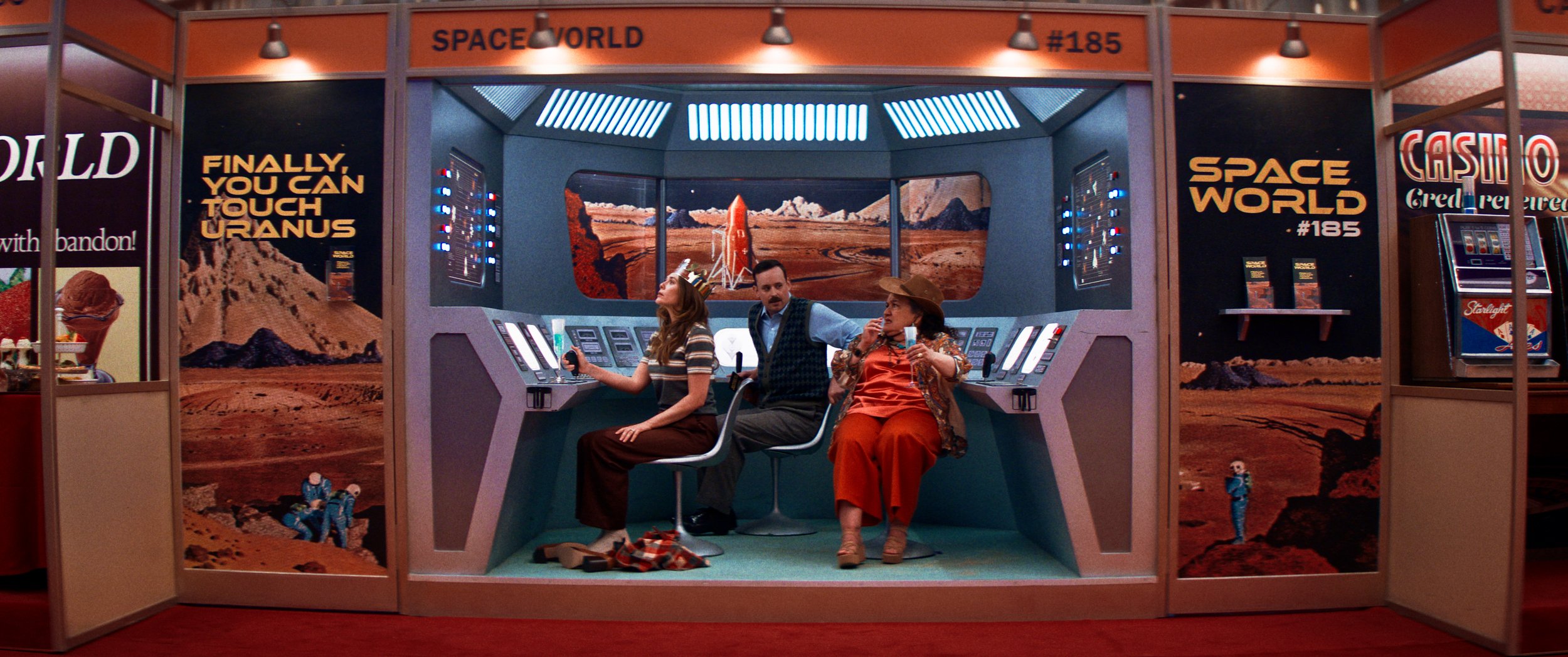
Joan, played by Elizabeth Olsen, inside the spaceship booth, with Karen, played by Olga Merediz in Eternity
Image courtesy of A24
AA: Were there any shots or sequences that were especially challenging to grade or difficult to get just right?
DT: The main floor of Eternity at times as there is a lot going on. These were some of the busiest frames, with a lot of different elements and actors at play which made it the most challenging, I think. But I want to give credit to the VFX house we worked with, Niche VFX, who helped realize the vision and made sure these backgrounds didn’t feel CGI-built.
AA: How did working on Eternity differ from your experience on other films, and in what ways did this project challenge or expand you creatively as a colorist?
DT: It challenged me in every way. This is the biggest budget film I’ve done and my first A24 film. It definitely challenged me, with so many VFX shots to integrate. This project taught me to trust my instincts. I’m really proud of the growth of everyone, including myself and my team, through this film.
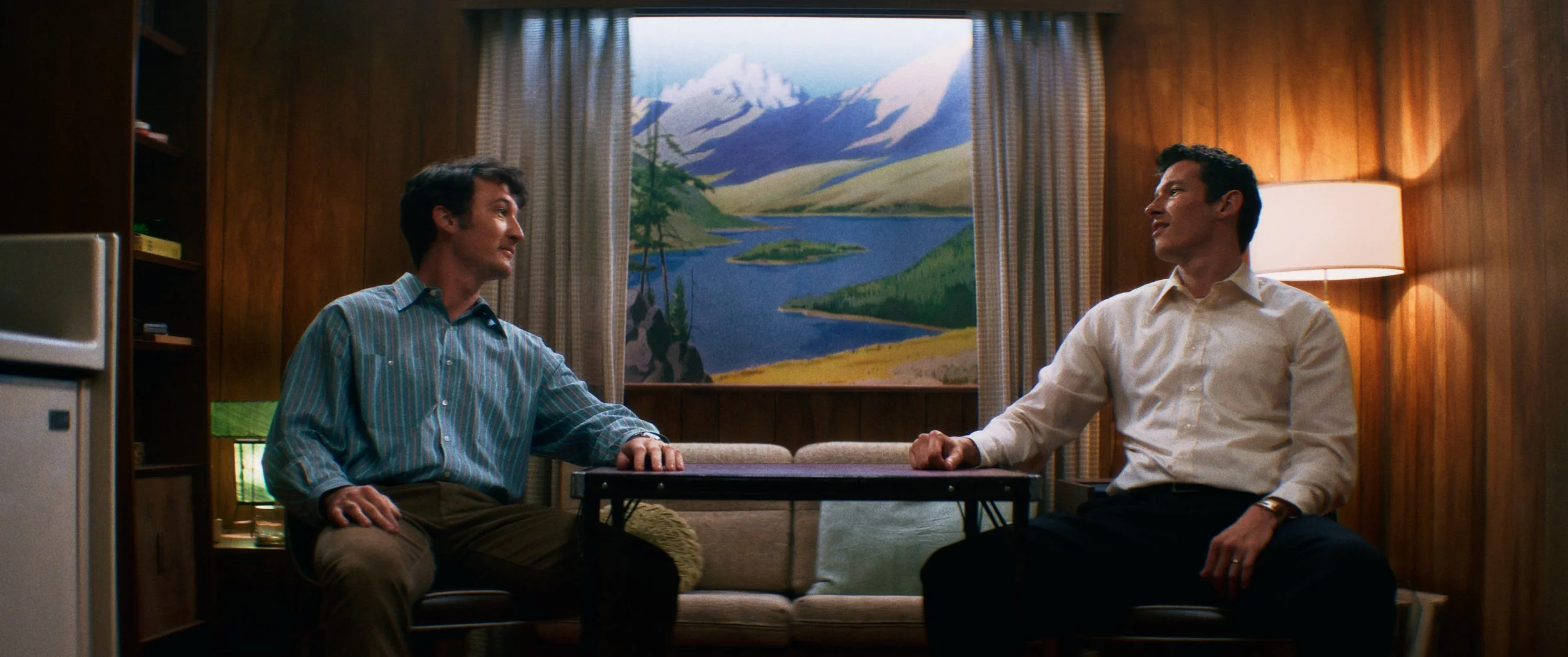
Larry, played by Miles Teller, with Luke, played by Callum Turner, in Eternity
Image Courtesy of A24
AA: Many of our readers are emerging filmmakers and students interested in entering the film and entertainment industry. Are there common misconceptions about the role of a colorist, or any guidance you would offer to those who are certain they want to pursue this career?
DT: My advice for creatives who want to get into color grading is to learn as much as possible by working on other people’s projects. Start with stock footage to master the technical basics, but challenge yourself creatively with music videos or student films for free, and be a sponge for the filmmaker. Remember, collaboration is 50 percent of the job, and it depends on how well you can extract the filmmaker’s vision and translate it through your tools. Finally, put yourself in intimidating situations where you may lack skill or expertise; these experiences help you learn faster and build foundational skills. Like anyone on set, you learn by being present and engaged.

Luke, played by Callum Turner, and Joan, played by Elizabeth Olsen, in Eternity
Image Courtesy of A24
AA: You mentioned how vital collaboration is between the colorist and the filmmaker. What advice would you give filmmakers on how to communicate more effectively with their colorist and build a strong working relationship?
DT: As a filmmaker, don’t wait until your film is in editing or locked to bring on your colorist. They can save time on set by suggesting solutions early. Involve your team from the beginning by sitting down with your production designer, director of photography, colorist, and director to share references and mood boards so everyone understands the vision.
This enlightening conversation with David Tomiak and his inspiring work on Eternity highlights how colorists are able to find the heart of a film through color, collaboration, and intention.

David Tomiak, Eternity Colorist and Co-Founder of Elemental Post
One of Tomiak’s most valuable pieces of advice for emerging filmmakers is to trust the process and be clear about your vision, as for the rest “when you bring enough creative minds together, sparks are bound to fly (Tomiak).”
Strike Out,
Writer: Andrea Arguello
Editor: Andrea Arguello & David Tomiak
Los Angeles