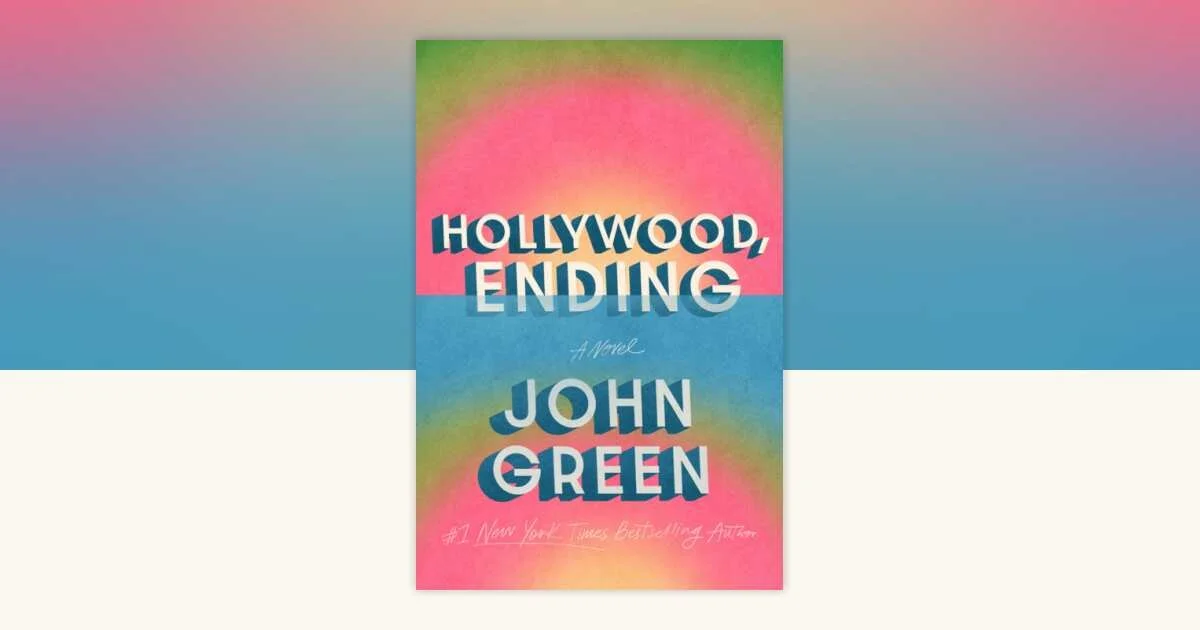
Image Courtesy: Penguin Random House
After nine years without publishing a novel, John Green released Hollywood, Ending on Sept. 22, 2026. His most recent books were nonfiction ventures, so fans were excited that Green returned to his roots, with a story reminiscent of his young adult novels that brought him fame and acclaim.
Hollywood, Ending is told from two perspectives, shifting between Juniper and Kai, young actors who serve as the supporting cast of a new biopic on the life of Andy Warhol, titled Andy Warhol Never Gets Old. The two bond over this experience, navigating burgeoning fame, the overwhelming nature of celebrity culture and the uncertainty of being in your 20s. In a statement, Green shared that his intention with the book was to detail the “strange, complicated exchanges of attention and trauma of the social internet that has become something no longer reserved for movie stars alone.”
This novel is an excellent follow-up to Green’s prior work. His young adult books notably center teenage girls, so the protagonists of Hollywood, Ending, who are in their early 20s, show growth in his writing and subject matter. After two decades of publishing, Green’s work had become familiar, and the shifts within his latest novel prove he can still write compelling original material.
The characters in Hollywood, Ending both face immense traumas that deeply alter their perceptions of themselves and who they can become, providing them with something to bond over, though they can never fully understand the other’s struggles. Juniper was a child star; her mother pushed her into a competitive and emotionally draining career at a young age, tying her worth to her ability to land roles and succeed as an actress. At the start of the book, her mom passed away recently, leaving Juniper without closure.
Kai is a kind, bubbly rising star. He shares his emotions easily and broadly, telling people he loves them as if it were the easiest thing in the world. His warm and open exterior masks a trauma he does not know how to overcome but is forced to confront. During the press tour for Andy Warhol Never Gets Old, Kai’s childhood abuse at the hands of his high school teacher is revealed and publicized, drawing attention to the movie at his expense.
Like any John Green book, Hollywood, Ending featured a slew of beautiful, heart-wrenching quotes exploring the many issues related to growing up. It is especially poignant through comparison. As the actors create and later promote their film, they learn more about Warhol’s connection with the cult of celebrity while navigating their own changing status. The entire cast is encouraged to read Warhol’s biography for their project, where they are told that Warhol’s work was shallow, yet groundbreaking.
“Warhol presaged the degradation of meaning in an image.” His pop art was deceptively simple, focusing on celebrity and advertising through bright colors. This bold, attractive work is almost a precursor to social media visuals, where content creators battle each other to create the most eye-catching posts.
Regarded as one of the most influential artists of the 20th century, Warhol maintained an elusive public persona, sharing his art but never himself. This stance is admirable and impossible within our modern culture, where everyone is expected to consistently post their lives for others to see. Film executives and producers have discussed casting actors based on online following instead of talent, expecting not just a commitment during filming, but continued press by wrapping the project into the performer’s online identity. Realizing this situation, Juniper declares, “I do not want to be loved by strangers, but I do not want to want most of what I want.” She has grown to love acting, despite being pushed into it by her mother, but the constant self-promotion is an exhausting game.
Green compares Juniper and Kai throughout the novel; though reluctant, Juniper feeds the marketing machine and posts as she is told. Kai, however, is more avoidant, hoping to maintain his personhood while the world around him sees him as a brand. He discusses the difference between real life and the things we post online, this false version of ourselves that we promote: “I remembered something my roommate had said to me once, that there should be a word for the distance between your actual life and your Instagram Life. She had proposed fictance.”
That word, fictance, is the most concise description of Green’s messaging. As someone who has been very publicly online for years — through his YouTube channels Vlogbrothers and Crash Course — Green has firsthand experience with the challenges of opening yourself to adoration and critique from thousands of strangers. While not a film star or a painter, Green understands that to survive in public is to build a façade, to clarify to yourself what is fictional and what is true.
Hollywood, Ending is a heart-wrenching story of discovering yourself when the entire world is trying to decide that for you. This novel describes finding someone who will love you when you don’t know how to love yourself. It is the perfect evolution of John Green’s work, aging with his fans to gift them the story they need to hear in the dawn of their adulthood.
Strike Out,
Orlando
Written By: Antonella Herrera Hernández
Edited by: Arsheeya Garg and Kaitlyn Clarke
Antonella Herrera Hernández is the Web and Social Coordinator for Strike Magazine Orlando. She is a senior at the University of Central Florida, majoring in Technical Communication and pursuing minors in Digital Media and Legal Studies. In her free time, she enjoys reading, watching romcoms, and trying new crafts. Throughout her pursuits, she aims to foster creativity and display her many passions.