
Love In Correspondence
Kafka was small. Growing up in an environment of chronic belittlement and lack of understanding, it was amidst the shadows of the man he would never be that he wrote. It wasn’t until he was 36 that he sat down to compose a 45-page letter to his father, describing in detail and grief how raising him without the hope of him ever becoming a man stumped him beyond comprehension. His father scorned and spit at him, Kafka was all he hated: a scrawny writer with no manly heart. This incapacitated Kafka in all further areas of life, never truly chasing after his dreams, belittling his capability to both write and fully become a man. Most acutely however, Kafka was incapacitated in love.
“The older I grew, the more I provided you with evidence of my worthlessness, gradually you really came, in certain respects, to be right about me”
I was fifteen and engrossed in the letters Kafka wrote. Even further, I became obsessed with understanding his philosophy – something he could never quite explain himself prior to his early death at forty in 1924. The fascinating prospect was this: Kafka, in all his suffering and scarred interior that was lashed from years of degradation, was the most intense lover I had known. As I picked apart the anatomy between the two lovers Milena Jesenská and Franz Kafka himself, I sutured myself to the pages of Letters to Milena – a collection of correspondences between them written between 1920 and 1923. I aim not to compare the love life of a high school sophomore to that of a poet, even less do I aim to draw comparisons between our standards. However, somewhere in between reading: “You’re always wanting to know, Milena, if I love you…” and "I'm not saying goodbye. There isn't any goodbye, unless gravity, which is lying in wait for me, pulls me down entirely – but how could it, since you are alive”, I gained the consciousness that love was not something mortal. Pulsing close to the ribs of the enamored, love exists in the liminal space between life and death. I began to find myself incredibly privileged to witness this immortalization: where a lover—despite his inability to love himself —became anchored to the love of a woman far from him. Fickle is the line between love you give and love you receive, so I wondered where Kafka mustered his capability not just to be a lover, but to be a lover from a distance. I began to fall ravenously in streams of correspondence.
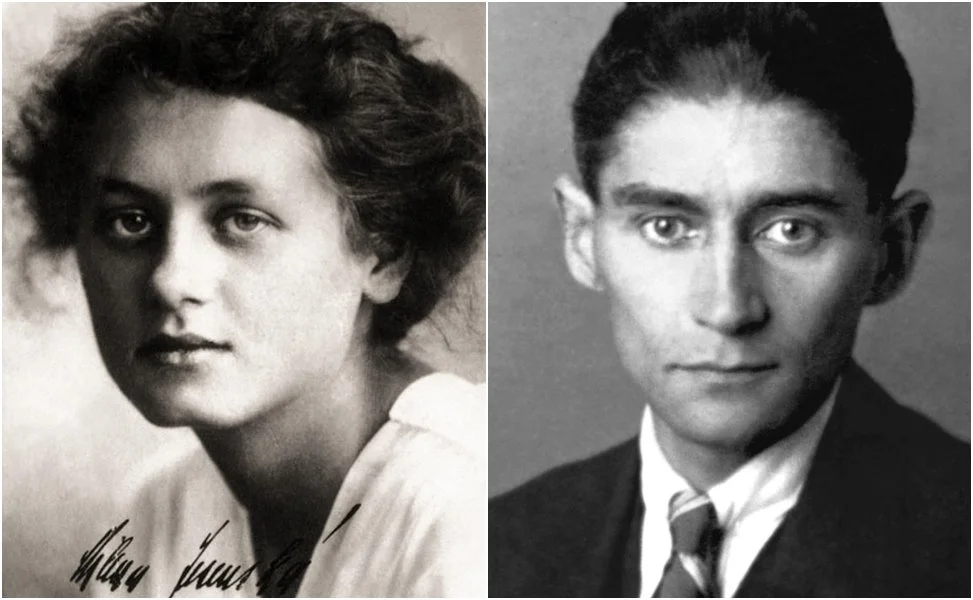
Images Courtesy of Profimedia
““I’d like to have all the time there just for you, for thinking about you, for breathing in you.” ”
Years later, I came to discover the letters between Vladimir Nabokov, the renowned writer of Lolita, and his lifetime partner Véra. Married for 50-years, their letters sing a much softer symphony of familiarity and recognition. Kafka and Milena had bitter undertones of forbidden distresses, Milena amidst an engagement. Their affair tested the limits of Kafka’s insecurities, his crippling health becoming the storm that took him. Combined with his self-loathing and fear of intimacy, it was doomed. Véra and Nabokov existed on a different plane, their physical distance throughout their marriage meant nothing as their words defied the boundary of separation.
“The thought that you exist is so divinely blissful in itself that it is ridiculous to talk about the everyday sadness of separation – a week’s, ten days’ – what does it matter? Since my whole life belongs to you.”
Much less complicated, I recognized that comfortability and companionship can exist amidst the knife. Sharpened by our fear of becoming mundane and insufferable, polished by the idea that craving compassion is embarrassing. Their love was a carefully woven detail, so amused by the bright colors of falling in and between loves, we grow desensitized to things much gentler and calm. I felt love in a simple greeting, love in the details we miss:
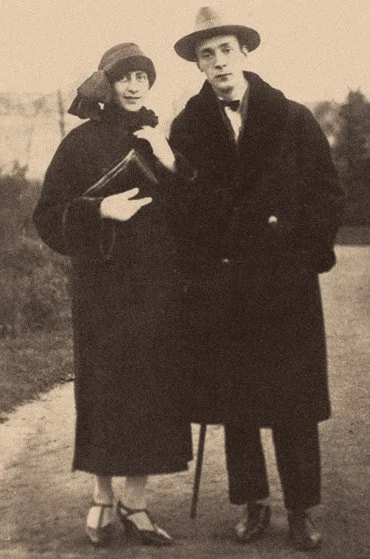
Véra/Vladirmir, Image Courtesy of Heritage Images
“My sweetheart, my love, my love, my love – do you know what – all the happiness in the world, the riches, the power and adventures, all the promises of religion, all the enchantment of nature, even human fame are not worth your two letters.”
Every word placed by pen, on paper, depicting consciousness of your love for someone else, is contributing to the everlasting of your emotion. Every sign off, from “Yours,”to “I love you. My sweet, I love you” is a perpetual sentiment. After you’ve split, after years have been spent in distance, your words are as bold as the day in which you wrote them. Whether written in anguish, or in inconceivable notions of admiration, you can stare at them unchanged and as young as the day you printed them. Your letters and notes never truly being left behind, somehow always succeeding you. Your words are held within the person you’ve addressed them to, along with them will go an unwritten promise that your emotions were once true. After consuming endless amounts of promise and prospect in the name of love and grief, every other modern form of romance begins to appear poignantly insincere in comparison. I look closer into every note, word, comma, and paragraph indentation. Not because I am a writer, but because I am a lover first— and words addressed to me extend beyond the page and into that space where love and loss exists.
“I want in fact more of you. In my mind I am dressing you with light; I am wrapping you up in blankets of complete acceptance and then I give myself to you. I long for you; I who usually long without longing, as though I am unconscious and absorbed in neutrality and apathy, really, utterly long for every bit of you.”
Strike Out,
Writer: Camila Turcios Hernandez
Editor: Ria Pai
Cami is an Editorial writer for Strike Magazine GNV. She lives vicariously through icons like Fancy Nancy and Summer Roberts, but realistically through much more somber ideas of Annie Erneux. She loves collecting jewelry, jokes, and Joan Baez facts, as we all do. If you ever feel inclined to contradict her ideas (which is hard cause women are never wrong), DM her at @camiturcioss on Instagram, or email her at camilaturcios1@gmail.com. For all other interests, her Pinterest is pretty awesome @11cheri.
