Did you catch that reference? Well, if you didn’t, someone else on stan Twitter definitely did, and is ready to geek out about it. Recently, a term has emerged on stan Twitter as a tool for pop culture discourse: “reheated nachos.” If you're chronically offline or the term has missed your timeline, reheating nachos refers to an artist or celebrity recreating, reworking, or referencing prior work — be it their own or someone else's. The term refers to the idea that when you reheat nachos, they aren’t as good as they were the first time around. But I think the fact that this term was invented to fill a lexical gap is very telling about the state of pop culture right now. Recently, it appears that there has been an increase in homages in pop culture, particularly in celebrity fashion, performances, and music. Is this trend simply filial piety to pop culture predecessors through iconic imagery to gain traction, or is it laziness and a lack of originality?
One of the most recent homages in pop culture has to be Sabrina Carpenter and her VMA performance, reminiscent of Britney Spears’ in her Dream Within a Dream Tour. Carpenter is no stranger to the homage, evoking images of Hollywood starlets like Marilyn Monroe with her bouncy blonde blowouts and catsuits. Her reference to Shirley MacLaine’s backless gown in What a Way to Go! was one of the first steps the singer took to solidify her image as a modern pop star with that timeless allure. While writing this article, Vogue Italia released a shoot where Carpenter emulates a 60s bombshell with a Mod eye look and tousled hair. Her appearance in the shoot bears a striking resemblance to Brigitte Bardot, as noted in Vogue’s comment section. It makes sense that Carpenter would pay homage to past blonde bombshells when her whole shtick is, “I just hopped out of a pinup poster”. Yet, when this image starts to feel like an amalgamation of borrowed looks and references, one is forced to ask: Is relying on homages a cop out to manufacture a persona?
I am going to take this moment to note I feel almost hypocritical asking about the overuse of homages. I adore references, and nothing makes me happier than geeking out when I recognize an artist’s reference, be it in fashion, film, music, or anything in between. But I find more than direct references, I appreciate a subtle allusion, an “if you know, you know” moment. When it feels like an artist is constantly hitting me over the head with a play-by-play recreation, I don’t appreciate it as much as if they had added a personal spin on the source material. And more than any kind of reference, I love new, exciting work. If we don’t make anything new now, what will we reference in the future?
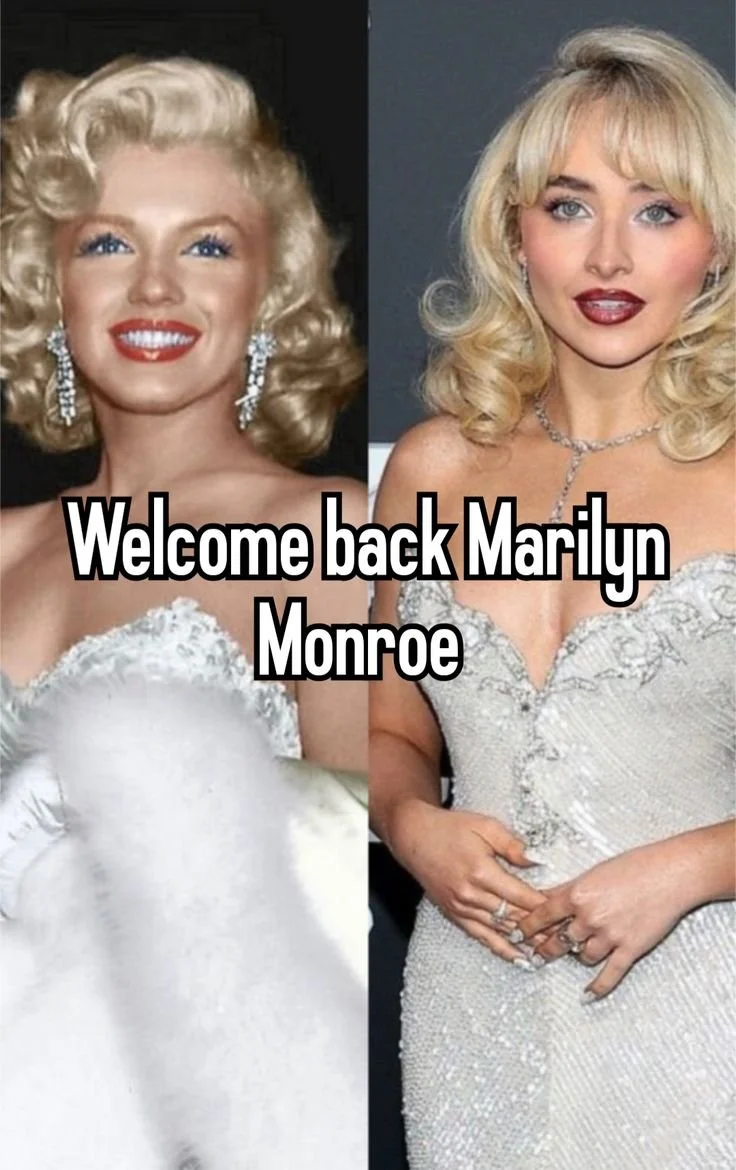
Image Courtesy: Pinterest
But enough disclaimers. Let’s get back to nachos.
Carpenter might be one of the more extreme examples of the use of homages. Because her brand is very retro, it makes sense that she would heavily draw from 60s source material. But being inspired isn’t unique to Carpenter. On the red carpet, both Anya Taylor-Joy and Kendall Jenner referenced Audrey Hepburn's iconic white and silver gown from My Fair Lady. Kim Kardashian famously and controversially donned Marilyn Monroe's crystal gown for the Met Gala. Plenty of celebrities are guilty of reheating the nachos of even their contemporaries. A past personal favorite, Gwen Stefani (and almost every blonde popstar like her) has been accused of appropriating Madonna’s image, who herself took lots of inspiration from Marilyn Monroe (How does it always come back to Marilyn?). Tate McRae has been hailed as the successor to Britney due to her dancing abilities, and some have gone far enough to say she might have dethroned the Princess of Pop. Doja Cat’s latest album cover, Vie, directly references “American Beauty", with the iconic bed of roses as her background. A few years back, Halsey released The Great Impersonator, where promotional photoshoots of the singer recreating famous album covers caught the attention of social media. Benson Boone has been accused of being a soulless copy of Harry Styles, an example where reheating an artist's nachos can actually pit you against the blueprint and leave you seeming less than satisfactory. Lady Gaga was accused of “microwaving her own nachos” with her latest album, Mayhem, as critics claim she was trying to relive her glory days of The Fame Monster and did not succeed.
Even with music, the songs of today all have a certain “sound.” What Twitter users dub as the “Jack Antonoff Apocalypse", recent pop songs have a synth element popularized by Antonoff’s production on many of Taylor Swift's songs. Swift’s confessional style of lyricism that uses poetic language has been the blueprint for up-and-coming pop singers, creating “Taydaughters”, such as Gracie Abrams and Olivia Rodrigo (and Sabrina Carpenter, but I’ll give her a break). Doja Cat put out “Say So”, and for the years that followed, it seemed like every pop song was disco-inspired. The most recent trend comes after the widespread success of Charli XCX’s Brat. Since the album’s release, many mainstream artists have tried their hand at hyperpop, with Selena Gomez putting out “Bluest Flame” and Camila Cabello coming out with “I LUV IT.” I think I can speak for most people when I say that homogenized mainstream media and the same flavors grow tired. Obviously, trends are an unavoidable part of pop culture. But when the scene is oversaturated with the same look, sound, and feel, it can make consumers of art feel bored.
Beyond music, photoshoots, and red carpet looks, some singers will base their entire singing genre on being "the new __ singer”. Malcolm Todd, an indie singer who rose to prominence late last year, kick-started his career by introducing himself as the “white Steve Lacy.” This marketing technique worked incredibly in his favor, as fans of Lacy were funneled into listening to Todd’s songs, which had similar lyrics, production value, and themes. Similarly, singers Remy Bond and the newly debuted Aimee Fatale have a dreamy, retro aesthetic that aligns with Lana Del Rey’s vintage Americana persona, consequently drawing in members from Del Rey’s fanbase. Using a preexisting niche to get a leg up in your career seems to be a model that works. In the age of algorithms, why wouldn't you use keywords and names that push you into the way of potential fans?
Regardless of practicality, I think we can agree that it isn’t the most genuine approach to art to purposely piggyback off another artist's image. Packaging yourself with someone else’s brand goes beyond taking inspiration from your predecessors, which I can admit is a very essential part of art. Entire art movements wouldn’t have come to be if they didn’t take inspiration from what came before: Rococo building off the ornate Baroque style, or R&B evolving from jazz, or even all the subgenres of alternative fashion that branched off punk. Art, be it fashion, music, film, or literature, isn't insular. It exists in the context of what came before it. Therefore, it’s understandable that contemporary work would reference and build off prior work. But there is a big difference between evolution and appropriation. One is natural and unforced, while the other feels a little gimmicky.
Now here’s the thing: The gimmick works. Let's go back to Sabrina. A singer, who started her career as a child star on Disney, actually launched her music career in 2014, around the same time she signed on for Girl Meets World. Carpenter had been putting out music for nearly a decade before she gained traction with her album “Emails I Can’t Send.” In this era, we see the emergence of her Polly Pocket-esque style with big boots, heart motifs, and glittery corsets. Her signature raunchy “Nonsense” outros for live shows introduced a provocative element to her style, which would later become a huge part of her persona. But it is with her 2024 album Short N’ Sweet (which, by the way, was done by Bruno Jumenier and recreates a photoshoot of French model Tiffany Collier for the album cover) that she leans into the sultry, girly, bombshell persona, heavily emulating past sex symbols like Bardot and Monroe. With much raunchier lyrics, risque choreography, and a consistent 60s style, Carpenter was going all in on the vintage vixen aesthetic — and it made her a household name. The star went from opening the Era’s tour to having her first-ever sold-out arena tour, as well as spending a year on the Billboard 200.
Similarly, Chappell Roan rose to stardom as a seemingly overnight sensation. But her success was far from sudden. The star had debuted in 2014 and was releasing music up until her breakthrough album, The Rise and Fall of a Midwest Princess. It was around this point in her career that Roan dyed her hair to be the recognizable red it is now and started incorporating elements of drag makeup and fashion into her style. Roan herself has admitted she drew inspiration from other queer icons like Elton John and David Bowie, and most famously referenced Sasha Colby when she said, “I’m your favorite artist’s favorite artist.” Compared to Carpenter, Roan references work more subtly, often extracting the vibe of her source material instead of flat-out recreating it.
It's normal for artists to spend time in the music scene before gaining relevance, but what I think is most notable for these two artists is the direct correlation between their sudden popularity and their adopted personas, which pivoted through references and homages. Their branding made them easily recognizable and acted as cultural shorthands that told their audiences, “This is what I am going to deliver.” Reheating nachos of personal icons and role models made personas so strong for Roan and Carpenter that it catapulted them to success.
This reveals two truths: it pays to have a persona, and more importantly, it's better if that persona has elements that are familiar to the audience. It's human nature to want to stick to what you know and love, so it makes sense that people will flock to a singer who reminds them of a past favorite. It also helps break down generational divides. Older audiences might feel more tempted to tune into a performance if there are aspects that remind them of their generation’s artists. Katseye has grown a significant millennial fan base despite being a strikingly Gen Z girl group, almost entirely because their camaraderie reminds audiences of girl groups like Little Mix or the lovable mess that was Fifth Harmony.
As a culture, we love references, things that remind us of what we love (To confess, when I recognized the “American Beauty” reference on Vie, I was thrilled). As a result, projects that emulate certain celebrities' iconic moments tend to gain more traction in terms of publicity, and it makes sense that labels and celebrities would try to do what would gain the most success. Reheating nachos is literally commercially rewarded.
I think the key takeaway here is that because it seems our feeds are inundated with derivative performances and red carpet looks, it feels like the culture has shifted away from originality and more toward reliving the glory days. The truth is, if you look hard enough, there are tons of art being put out that’s unique and genre-bending. While this may manifest in more underground and indie scenes, consequently not receiving mainstream attention, it's there, and it's valuable.
One of the biggest parts of art is taking risks. Putting yourself out there and making bold choices is what distinguishes you as a creative. It is safe to err on the side of what’s tried, tested, and true, what’s loved by audiences. But that doesn’t show thought or personal investment in projects or your work. It feels impersonal and manufactured, and with no risk, there comes no substantial reward. In this case, that reward is being remembered as a visionary, a trailblazer, a genre bender. To this day, people still reference Lady Gaga’s meat dress or Nicki Minaj’s quirky Harajuku-pop style. Even when you take off the nostalgia-tinted lenses, those moments were unprecedented and cemented the stars into pop culture canon. Can the same be said for artists who choose to be a different version of someone else? The reheating nachos epidemic is obviously encouraged by the commercial success that comes with homages and references. But when this fleeting commercial success fades away, is anything substantial left behind?
Strike Out,
Orlando
Written by Rosita Mechérie
Edited by Sarah Franquelo and Liv Wagner
Rosita Mechérie is a Staff Writer for Strike Magazine Orlando and a Freshman at the University of Central Florida, where she is majoring in Journalism and Film. Rosita is a self-proclaimed fangirl, an aspiring cinephile, and she could talk you to death about anything pop culture. She hopes to have a career in entertainment journalism and eventually write a novel or two. Reach her at rositamecherie@gmail.com or @rositamecherie on Instagram.