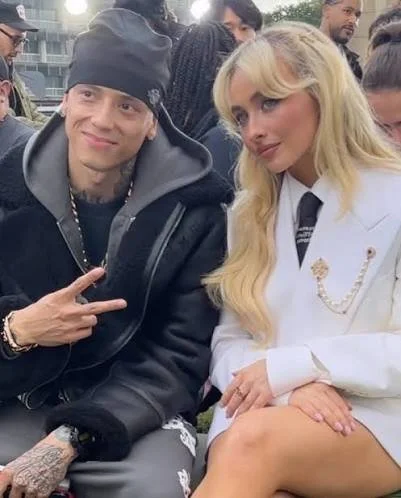
Image Courtesy: @viralpopculture
Living in South Florida, where summer never seems to end, means keeping a wishlist full of fall clothing you’ll never actually need unless you crank the AC cold enough to fake experiencing some type of fall weather. But for the fashion girlies, true fulfillment was never about the seasons anyway, it was about a front-row seat during fall fashion week.
Milan, New York, London, and Paris are the top four global fashion capitals that host the world’s biggest and busiest fashion weeks from mid-to late September every year. Fashion shows are the driving factors within these weeks that produce not only a presentation of a designer’s collection or the launch of seasonal trends, but a spectacle for marketing and business.
The front row was considered discreet access to an elitist society; it has since transformed into a structure where the attendees of a fashion show are nearly as important as the models on the catwalk. Social media creators have become a large part of New York Fashion Week (NYFW) because they give runway shows a channel to reach millions more people. From a public relations standpoint, it’s also about getting talent in the right rooms to meet teams and cooperate on future projects.
The front row of a fashion show marks a hierarchy that is much more intricate than it appears; it functions as a primary tool for public relations, strategically blending status and media value. The brand’s public relations team decides who gets invited, who gets the front row, who sits beside whom, and sometimes even the position for the photographers. Take Sabrina Carpenter and Central Cee, photographed in the front row of the Louis Vuitton spring-summer 2025 menswear show in Paris, who suddenly became a circulated topic on social media. Both being music artists with a younger demographic, the duo gained enormous media attention simply from the idea of a potential collaboration.
It doesn’t have to be a celebrity next to a celebrity, however. Within the fashion industry, seating alone can spark entirely new lines of communication. A celebrity with an editor can connect a celebrity with a brand’s voice. A celebrity next to an influencer can connect social media reach with traditional press. A buyer next to an editor can create a business relationship within the industry. The brand is ultimately thinking about how many benefits it can generate from one show.
Savannah Engel, CEO of Savi PR, explained the “Fashion GPS” system that fashion shows use for the science behind seating charts. She said the system uses color-coded dots to describe attendees: Green equals press. Blue equals sponsors. Orange equals VIP. Press members are seated with editors and chiefs, while fashion directors sit with their assistants positioned behind them. Every name on the seating chart also carries a return on investment or an ROI. Every guest is expected to generate some measurable value in exchange for their seat. For retailers, that ROI is direct: after the show, they can meet with the brand's market team to discuss the collection, share feedback on what caught their eye, and place wholesale orders for stores like Bloomingdale's or Saks.
Every name, every color-coded dot, and every placement of an attendee at a fashion show helps carry a name. Some get excited for autumn. Others get excited for fall fashion week. Either way, we watch something unfold, whether it’s leaves, or headliners.
Strike Out,
Derin Alyanak
Boca Raton
Derin Alyanak is a content writer for Strike Magazine Boca. As a journalism student and self-diagnosed shopping addict, you can find her adding more items than she can afford to her Pinterest wishlist or curating another Spotify playlist. Reach her by email at @derinalyanak1@gmail.com or on Instagram @derinalyanakk