

Image courtesy: Pinterest
Sometimes, when listening to a song, it’s like you're being transported directly into it. The lyrics tell a story so clear and vivid that it’s as if you’re watching a movie, the song building a world around you. Other times, you’ll listen to a song and think to yourself, “What is even going on?” I love it when the latter happens.
Not to water down all the nuances and gray areas that exist in music, but for the most part, songs tend to fall into two broad lyrical categories. There is the diaristic, confessional style, where you’re being told exactly what is happening, and you can follow the plotline with ease as you listen. Think Taylor Swift writing, “Midnight, you come and pick me up, no headlights. Long drive, could end in burning flames or paradise.” With these lines, it’s as if we’re watching the events she’s describing play out in front of us. It’s almost like reading her diary. On the other end of the lyrical spectrum, we have the ambiguous poetry style. It may take a few listens or some intentional contemplation to determine what the artist is actually talking about, and even then, it could still be interpreted in a way that applies to each listener’s personal interpretation. Think Elliott Smith writing: “They walk in a circle, through all the sidewalk scenes that they used to be a part of one time. Now, everybody just stares and whispers.” This line is also telling a story, but it feels much more coded and abstract in comparison.
I’m not claiming that one of these songwriting styles is inherently superior to the other, because that ultimately comes down to personal preference, and writing lyrics in general requires an artistic prowess that the average person does not possess. In one of my favorite songs, “Your Summer Dream” by The Beach Boys, we hear, “Smell the warm and salty air, see a wave reflect a beam. Stop and find a pretty shell for her, make it real, your summer dream.” This song is gorgeous, and the lyrics undeniably work well with the atmosphere of the song; however, they make it so that no deeper thought is required to understand the story, and they are not very powerful or affecting, in my opinion. Upon taking a broad look at the music that I listen to, I realized that most of my favorite artists employ a less straightforward writing style. Obviously, for me and other people who similarly cherish these artists, there is something very impactful to be found in lyrics that don’t straight-up tell you what is going on.

Image courtesy: Pinterest
The first artist I had this realization in relation to was one of my all-time favorites, Led Zeppelin. One of the most defining bands of the 1970s (as well as rock music in general), almost everyone has heard at least one of their songs before. For a long time, “The Rain Song” had been one of their most striking songs. Seven and a half minutes long, I’ve always enjoyed the drawn-out nature of the song; how it starts slow and serene and ends in a crescendo with Robert Plant belting out the lyrics over blazing drums and guitars.
But further than enjoyment from a purely musical standpoint, this song has lingered in my mind for its emotional themes as well. Describing the different stages of one’s romantic life through a seasonal metaphor, the lyrics talk about the warm, blooming feeling of love and contrast it with the cold, challenging feelings of loneliness. I did not immediately grasp all the exact meanings of this leading metaphor, however, because the lyrics are just open enough to leave the listener with room to wonder and interpret on their own accord. Instead of giving a plain, lyrical rephrasing of “we all must go through ups and downs in our love life,” Jimmy Page and Robert Plant imbued the song with an unassuming potency by writing, “These are the seasons of emotion, and like the winds they rise and fall. This is the wonder of devotion, I see the torch we all must hold. This is the mystery of the quotient, upon us all a little rain must fall.” By not spelling it out, the song allows the listener to interpret these lyrics in their own way, which can often produce a stronger resonance than if the lyrics held an obviously defined meaning.
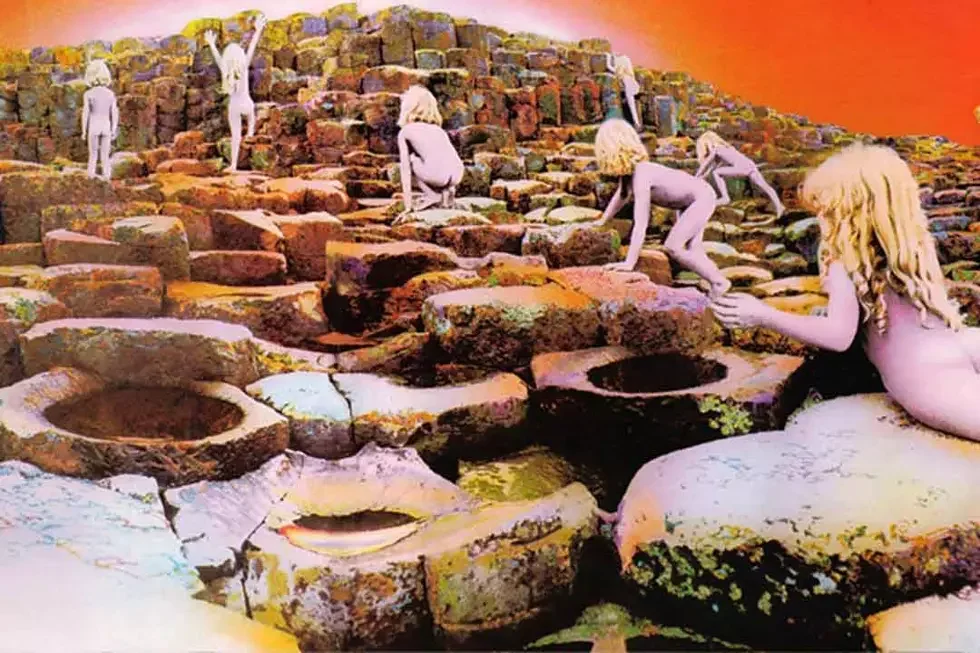
Image courtesy: Ultimate Classic Rock
Another artist whose lyrics I have found deeply touching is Weyes Blood, particularly within her acclaimed 2019 album, Titanic Rising. The record amassed popularity for its dreamy, atmospheric sound and its visuals that evoke sensations of simultaneously being underwater and floating in space. Out of the album’s ten songs, a standout for me is “Movies.” It has the same sonic charm as the rest of the album, but the lyrics in particular are especially appreciated by me due to their vague, poetic nature. Over an eerie, ethereal instrumental, Natalie Mering (the woman behind the Weyes Blood stage name) croons out the lyrics, “Why did so many get a rise out of me? I love the movies. Some people feel what some people don't, some people watch until they explode. The meaning of life doesn't seem to shine like that screen.” To me, this song is about romanticizing an idea of what life could be like due to young exposure to romantic, extravagant films, only to be confronted with the harsh, dull realities of life and all the confusion they bring. She takes on a confessional approach to her lyrics here, but still lets her words float freely, not tied to a clearly stated narrative or any binding meaning. Her words don’t spell out to the listener, “My love of movies has made me end up disillusioned, and life isn’t as straightforward as I thought it would be. I’m not experiencing the things I thought I would.” She uses lyrics that could have no clear message outside of the context of the song as a whole, and because of that, the meaning of her words remains somewhat veiled. Who knows if my interpretation is even what she originally intended?

Image courtesy: Pitchfork
The real power of ambiguous lyrics is that they leave the listener with remaining curiosities and room to explore various potential meanings within the song. In “Pale Blue Eyes,” Lou Reed sings, “If I could make the world as pure and strange as what I see, I'd put you in the mirror I put in front of me.” In “I Have a Woman Inside My Soul,” Yoko Ono trills, “I see an asphalt road inside my soul. It’s pale even in a warm summer’s day. It stretches into the mist and calls me, but I don’t know what it takes.” I have fallen in love with these songs more and more with each listen, because every time I play them, I discover something new in their words. With their poetic lyricism, which leaves just enough undefined and available for the listener to uniquely interpret, there exists a magic within them that I don’t find as much of in lyrics that state everything in a clear, linear story.
Strike Out,
Writer: Annaliese Long
Editor: Daniela Mendoza
Graphic Designer:
Tallahassee