
Sometimes, when watching a Schiaparelli show, maybe even a Nara Smith TikTok, I see an unbelievably abnormal piece of clothing and get irrationally mad.
Maybe I don’t understand it.
It feels like a PR piece created to go viral as opposed to raw, innovative art, and I hate that. I struggle between appreciating that fashion is pushing boundaries and recognizing that perhaps fashion has gotten so obsessed with the idea that designers will make something totally meaningless and label it “avant-garde.”
I’m sorry, but why should I think your dress with five sleeves is groundbreaking? Am I just judgemental, or am I right? Isn’t fashion supposed to be wearable art? Does a piece made just for shock value disqualify it from being categorized as art?
Most importantly: when does weird become art?
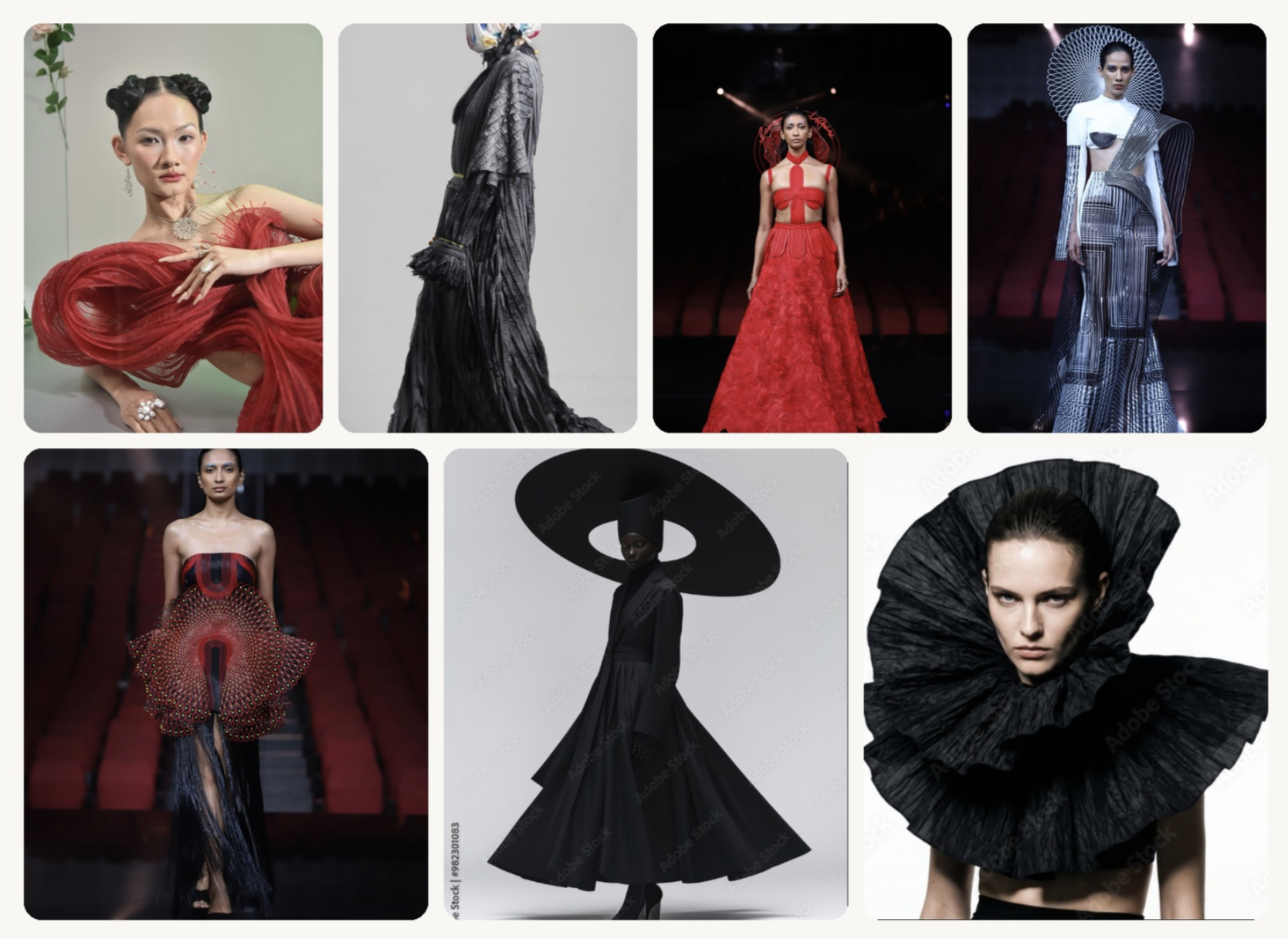
My avant-garde Pinterest board
Courtesy of Angelique Rodriguez
My AP French knowledge tells me “avant” means “forward,” or “in front of,” and “garde” directly translates to “guard.”
The phrase started off as a military term hundreds of years ago, meaning “advance guard,” used to describe French troops bravely marching to the front to defeat enemies. They were an avant-garde, pushing physical boundaries.
A 19th-century theorist, Henri de Saint-Simon, used this term in a social and artistic context, for the first time, in a book about his philosophical opinions called “Literary, Philosophical and Industrial Opinions.” He wrote:
“We artists will serve you as an avant-garde, the power of the arts is most immediate: when we want to spread new ideas we inscribe them on marble or canvas. What a magnificent destiny for the arts is that of exercising a positive power over society.”
Artists are at the forefront of modern thought, according to Saint-Simon, bringing innovative ideas and a new era to culture and society. To be an avant-garde artist is to be aesthetically and culturally progressive.
I think of Andy Warhol, king of the Pop Art movement, who is most well known for those seemingly meaningless Campbell’s soup paintings. Before studying him in art class, I thought his work was sooo stupid. Everyone else did too.
When he created Campbell’s Soup Can 1 (1968), he was criticized and considered talentless. This was at a time when Abstract Expressionism– which focused on expressing the emotional and psychological human state rather than realistic, everyday objects– ruled high art, so to see a bunch of painted soup cans lined up on shelves like a supermarket aisle enraged the public.
His gallery show did terribly, with only five of his works selling for $100 apiece. One critic publicly dismissed Warhol and his work, saying he was either a "soft-headed fool or a hard-headed charlatan." The Campbell Soup Company was equally unamused; company lawyers visited the gallery and threatened a cease-and-desist order.
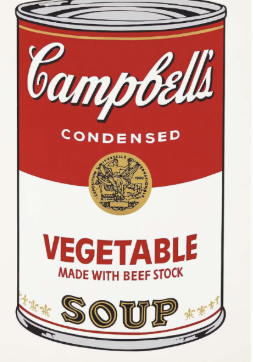
Andy Warhol, Vegetable, from Campbell’s Soup I (1968). Screenprint. F. & S. II.48.
Despite its mundanity, it was meant to challenge what artistic talent entails. Warhol thought, what constitutes art? Is it always supposed to be this extraordinary, meaningful piece? He took everyday products, like Campbell’s soup cans, to high society art. It was a protest against the serious, exclusive nature of Abstract Expressionism and the academic museum culture that artists like Warhol felt had nothing to do with daily life. It was a commentary on the exclusivity of high art and an argument that art should be for everyone, not just the academic elite. His questioning argued there doesn’t need to be a deep meaning attached to artwork; art can just be art because it’s human-made.
The movement was meant to shatter those traditional boundaries by infiltrating high art with everyday products. Artists began incorporating bits of imagery from popular advertising, comic books and Hollywood movies into their pieces. It resulted in what we've all seen today, those vibrant portraits of 1950-60’s icons like Marilyn Monroe featuring onomatopoeia like “wham!” and “pop!”
Today, Warhol’s been praised in every art class I’ve taken for pushing the boundaries of art– what it is and what it can be. The Campbell’s Soup Series is now often considered the definitive introduction into the American Pop Art Movement, and in 1996 it was sold to the Museum of Modern Art for a whopping $15 million. The Campbell Soup Company went from threatening legal action to actually sponsoring Warhol’s later work.
If I can understand that art doesn’t need to be poignant and intellectual to be meaningful, a Schiaparelli dress becomes much simpler in all its extravagance.
We’ve all seen some of Schiaparelli’s insane looks on the Met Gala red carpet via the internet. Doja Cat’s look at the Schiaparelli Haute Couture Spring/Summer 2023 show, in which she dressed head-to-toe in red and was covered in 30,000 Swarovski crystals, really confused me when it went viral.
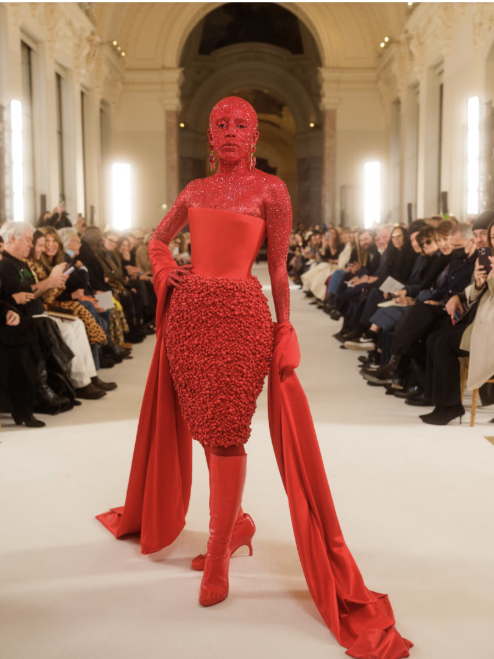
Photo by David Fisher/Shutterstock
I thought: why? I’m sorry, but it’s literally so ugly.
However, what I couldn’t say was "I've seen this before”.
It is a huge fashion moment that I still remember years later. Knowing Doja Cat is famously eccentric and expressive with what she wears, I recognize now that this was an act of expression. Why was I so judgmental in the first place, then, if I’m all about meaning in art? Maybe she was ahead of her time, much like Warhol.
I ultimately found that the 19th-century theorist was right. When we keep pushing these never-before-seen, avant-garde works of art, it ushers in new eras of thought and culture. Yes, something we’re unfamiliar with might confuse us sometimes, but to think we should just remain shackled to traditional silhouettes, forms and ideas is just outdated.
The verdict is, art can be art either way. When art seems created solely for shock value, look inward. You might find there’s a meaning, story, and moral to it. Like Warhol, artists can negate without words what is traditional. Art is reactionary, acting as an avant-garde urging us into new eras of thought. I’ve discovered that nothing ever has no meaning. Sometimes, the things that are seemingly meaningless make way for meaningful expression and provoke thoughts like, “when does weird become art?”
Strike Out,
Writer: Angelique Rodriguez
Editor: Camila Turcios Hernandez
Copy-Editor: Steffi Sarmiento Mena
Angelique Rodriguez is an editorial writer for Strike Magazine GNV. Her favorite things: the color purple, any Drake song, and butterflies. When she isn't consumed in her writing, you can probably find her watching a romantic comedy, flipping through a Vogue magazine, or getting ready for a party. You can reach out to her by email @angeliquesrodriguez08@gmail.com or on Instagram @aangierrodriguez.
