
When the Outfit Makes the Music Video

Image Courtesy: People
The earliest “music videos” emerged as dramaticized filmed performances. One of the earliest examples was Bessie Smith’s appearance in the short film St. Louis Blues (1929), in which she performed the titular song. Other artists in this time period took part in similar projects, providing voiceovers for animated versions of their music while linking deeper emotion to their lyrics.
My generation has grown up spoiled for choice with a plethora of music video content to consume, admire, and critique. Platforms like MTV and VH1 consistently streamed music videos while I was in elementary school, igniting my fascination with the concept of a “pop star,” their songs, and their outfits.
As a 2000s kid, pop icons like Lady Gaga and Britney Spears opened my eyes to how extravagantly stars could dress and proved how uniquely and fearlessly they could approach fashion through their art. Their stylistic choices represented the deeper persona behind the clothes, imaginatively offering bits of themselves to the viewers with each performance. The act of sharing one’s aesthetic through music and fashion became an effective tool for self-expression way before the 2000s and still exists today in pop culture.
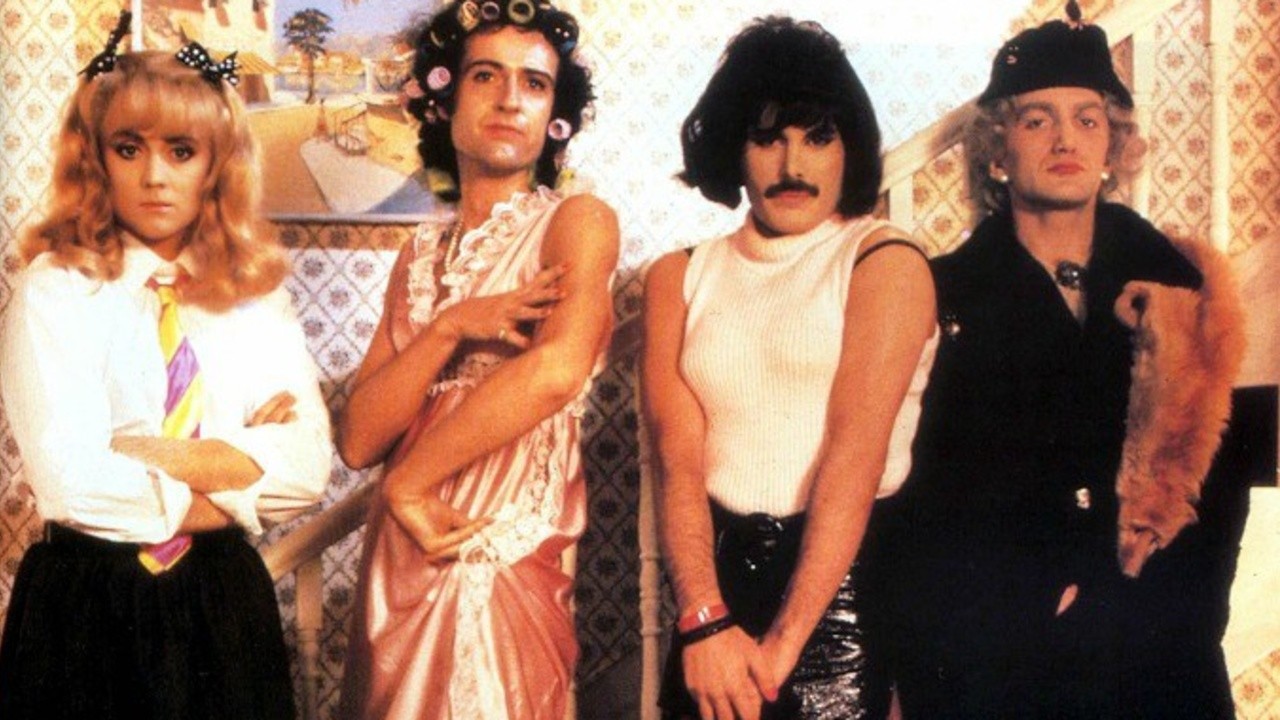
Image Courtesy: MUBI
Queen: Breaking Free
The British rock band Queen released the music video to their hit song, “I Want To Break Free,” in 1984. The all-male band cross-dressed as stereotypical housewives, drawing inspiration from the British soap opera Coronation Street. The video left critics feeling uneasy, and MTV refused to air it, which tanked the song’s popularity in the United States.
Guitarist Brian May went so far as to say “this incident diminished the band's success in the U.S. throughout the 1980s,” according to Entertainment Weekly. Drummer Roger Taylor also argued that “MTV was very narrow-minded,” claiming that their music video was not “rock enough” — in other words, it was not “masculine enough.” Nonetheless, this video was a big moment for the band; they carried on no matter the reception. Lead vocalist Freddie Mercury took the brunt of the backlash, particularly because of the link to his gay allegations. Perhaps America resisted welcoming the idea of cross-dressing back in the ’80s. Still, “I Want To Break Free” demystified the possibility of gender fluidity in music videos.
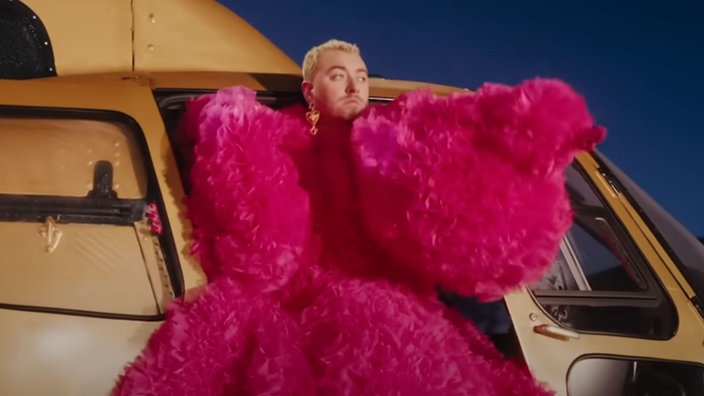
Image Courtesy: Tiger Times
Sam Smith: Corsets & Confidence
Pop artist Sam Smith began their career in the 2010s, offering a soulful sound to their ballads. Their early music videos featured black-and-white film, sinking into the essence of heartbreak through cinematography. The wardrobe stayed rooted in classic black suits, as the voice was the main focus. After coming out publicly as non-binary in 2017, Smith began a new journey of self-identification through their music and personal style with albums like The Thrill of It All and Love Goes.
In 2023, they released the music video to the hit song “Unholy,” collaborating with Kim Petras. In the video, Smith wore a version of the usual suit while exploring an added layer of sensuality with a tight black corset underneath.
“I’m Not Here To Make Friends” pushed the envelope further with feathered headresses, elaborate feathered coats, glamorous shimmery corsets, nipple coverings, mega-high-heeled pumps, and sequins galore. The musical theatrics met the costuming halfway, allowing Smith to explore their sensuality and femininity with each look. According to People, Smith discovered a newfound confidence in taking on these glamorous looks: “It paid off because I now have the opposite of body dysmorphia. I look fabulous.”

Image Courtesy: Pinterest
Harry Styles: The Jumpsuit Era
It takes time for some artists to gain the confidence to fully express themselves stylistically, and former One Direction member Harry Styles is a popular example. During his boy band phase, his outfits in music videos stayed pretty on par with the typical 2010s aesthetic of groups like Five Seconds of Summer and Big Time Rush.
Launching his career as a solo artist in 2016 with his album Harry Styles, he considered what kind of artist he wanted to be individually. Since then, he released music videos featuring a more colorful palette with albums Fine Line and Harry's House. The 2022 music video for “As It Was” showcased Styles in a red sequined jumpsuit, moving with a sense of freedom and further emphasizing the innate comfort he felt in this outfit. Styles continues to push against gender stereotypes in pop culture using music videos, red carpet appearances, and performances to dress in a manner that fully embraces his range in style.
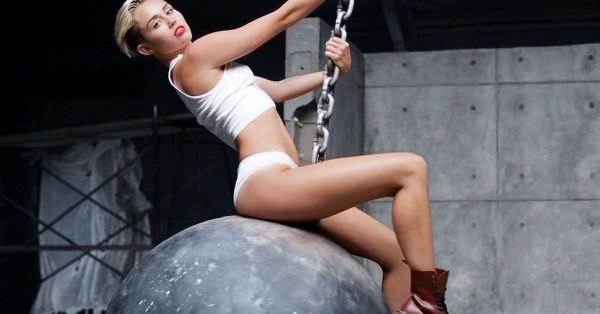
Image Courtesy: WKND
Miley Cyrus: Breaking the Mold
One of the most jaw-dropping, iconic artist evolutions of the last few decades has been with Hannah Montana star Miley Cyrus and her 2013 song, “Wrecking Ball.” The music video for “Wrecking Ball” came as a shock to most fans who knew Cyrus from her Disney Channel era.
In this extreme yet powerful video, we see Cyrus with an undercut pixie haircut, wearing only a white crop top, white underwear, combat boots, and red lipstick. Fully stripping herself of her Disney past with this look, she swings on a wrecking ball into a cement wall, which parallels her new aesthetic, breaking into the industry.
Many adults condemned Cyrus’s severe transformation. The Guardian writer Michael Hann argued, “Cyrus does send a message: that the best way for young women to be noticed is to sexually objectify themselves.” Although more impressionable audiences might see this as an invitation to “sexualize” themselves, an adult audience needs to respect a woman’s choice to embrace her body, whatever that may mean to her.
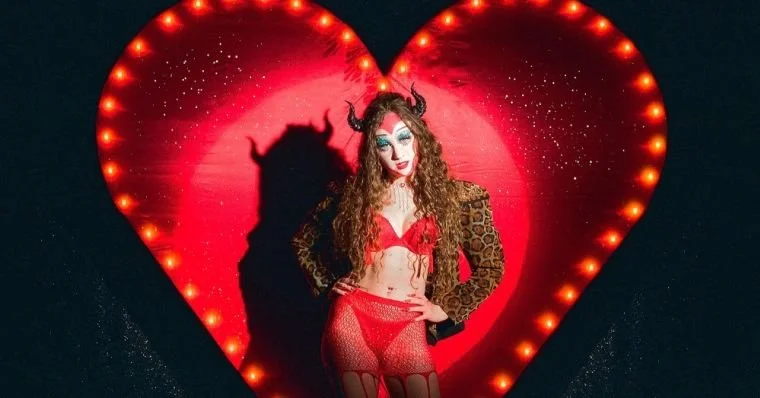
Image Courtesy: ffm. to
Chappell Roan: Camp Carnival
More recently, pop star Chappell Roan came into the industry with a fresh, carnival-like aesthetic, including statement fashion pieces, influences from drag culture, and lots of red. She held no hesitation in diving right into her intensely individualized style with her music videos. “Red Wine Supernova” and “My Kink is Karma” are standouts, representing her taste with beautiful execution.
Roan’s iconic long red curly hair matches her bedazzled cabaret-like corsets and coats in “Red Wine Supernova.” Playing with magician attire, she styles gold fringe, devil horns, and a bow tie choker, adding a seductive layer to the look. In “My Kink is Karma,” artists painted a huge heart on her face, leaning into the carnival makeup. Her red sparkly fishnets and tasseled bra, along with the vintage cropped cheetah print jacket, are a dead-on representation of her campy music and outgoing personality as a singer. After viewing almost all of her music videos, especially her most recent, “The Subway,” I have learned that when it comes to Chappell, either go big or go home.

Image Courtesy: The Guardian
Lady Gaga: Fashion as a Mask
No discussion about music video fashion would be complete without the queen of pop fashion herself — Lady Gaga. Since the 2000s, Gaga has been wowing audiences with her unconventional and overwhelmingly innovative style, which she morphs into every one of her videos. As a fan myself, I did not know what she truly looked like for many years, as she used her extravagant costumes as a mask, switching from persona to persona depending on what the song called for.
The music video for “Bad Romance” has a wide array of costume changes and remains one of the most interesting style concepts in music history. Alexander McQueen’s chunky, glittering, out-of-this-world design above commands attention, along with the Haus of Gaga outfits worn by her background dancers. Gaga uses her magnetizing aesthetic to help inform her character; every look she embraces is a new side to her that fans get to be a part of. Gaga makes incredibly courageous fashion choices that leave lasting marks on this industry and never fail to amaze.

Image Courtesy: Best In New Music
The Final Look
Music video fashion not only decorates a performance but defines an era, reshaping public perception and cementing an artist’s legacy. Nirvana proved that even anti-fashion could become fashion, inspiring a generation to adopt a deliberately messy, indifferent look that still influences a range of people today. Britney Spears, with “…Baby One More Time,” demonstrated that a look does not need a massive budget to make history.
Spears’ now-iconic schoolgirl outfit, pieced together from Kmart finds costing less than $17, reshaped her image overnight and became permanently etched into pop culture. Lana Del Rey built an entire cinematic universe through an Americana aesthetic. She channeled Marilyn Monroe’s diamond glamour in “National Anthem” and later wrapped herself in an American flag in “Ride,” effectively birthing a nostalgia that audiences would come to associate with her name.
In each of these cases, the outfit did not simply accompany the music but cannibalized it and transformed the artist into something substantial. These artists prove that when fashion meets performance in a music video, the right look does not just reflect identity — it creates it.
Strike Out,
Writer: Jacqueline Galvano
Editor: Salette Cambra
Graphic Designer: Eliza Crawley
Tallahassee