Collective vs Corporate Humanity: Enjoying Project Hail Mary During a Tipping Point in Space Exploration
If you’ve been on the internet lately, you’ve probably heard of Project Hail Mary. Maybe you’ve seen Ryan Gosling glow against a backdrop of stars, or some adorable but unidentifiable rock-like creature appear on t-shirts. Project Hail Mary, commercially, has been a great success. Not only did it recently surpass 300 million at the box office, but it also only suffered from a 5% box office drop between its first and second week— a drastic improvement from typical movies’ 50% decrease. But why has this movie been such a success? Was it because of the main character, Ryland Grace’s undeniable charm, or the stunning cinematography?
I would argue that the movie’s success comes from something deeper. At its essence, Project Hail Mary is an exploration of humanity, and I think the world right now is searching for that reminder.
Project Hail Mary is a film that prioritizes addressing extinction-level events with global efforts instead of national ones. While the head of the film’s international task force, Eva Stratt, concedes that her still-drastic death toll estimates are based on “assuming that the nations of the world will come together to ration food, which they won’t,” this is one of the only mentions of national interests overriding the common goal. Even facing catastrophic stakes, Project Hail Mary offers an optimistic perspective on politics: if necessary, the nations of the world will come together. Ryland Grace happens to be an American protagonist, but the majority of the people he works with before launch are not Americans. The ability to assemble a task force, build an interstellar spacecraft, and conduct rigorous science on such a time crunch required a combination of global resources and, even in fiction, would not have been possible with one nation alone.
The contrast between global cooperation and competition is one that has plagued real space exploration as well. While the Cold War and resulting Space Race were arguably the direct causes of human spaceflight, a shift from intense competition to international collaboration occurred immediately after. The Apollo-Soyuz Mission symbolized this shift. For the first time, astronauts from America and the Soviet Union met in space to demonstrate a new era of international teamwork.
In the media, space has been consistently romanticized as a place without national borders, a “final frontier” for exploration. While some argue that space exploration is a necessary step to preserve humanity, I argue that we explore space because we want to know what’s out there. People have been searching the stars for meaning for our entire existence, but in the last century, we can finally reach them. In A Pale Blue Dot, one of my favorite science authors, Carl Sagan, calls upon the Biblical analogy:
“We were to be kept ignorant. But we couldn’t help ourselves. We were starving for knowledge—created hungry, you might say. This was the origin of all our troubles. In particular, it is why we no longer live in a garden: We found out too much. So long as we were incurious and obedient, I imagine, we could console ourselves with our importance and centrality, and tell ourselves that we were the reason the Universe was made. As we began to indulge our curiosity, though, to explore, to learn how the Universe really is, we expelled ourselves from Eden. ”
Project Hail Mary equates the pursuit of knowledge with the definition of humanity. Grace is a reluctant hero in every way. He states quite bluntly that “some people are failures; some people don’t rise to the challenge.” Bravery and “rising to the challenge” are major themes of the film, but I think one of Grace’s bravest moments is underrated. During his second meeting with Rocky, the alien insists that Grace take off his space helmet, something that would require an act of immense trust, and Grace initially refuses. But he’s been alone for weeks at this point, and this is the first moment of “human” interaction that he’s faced. Despite his rational mind, despite his inherent self-preservation, he decides to risk his life to connect. In that moment, the possibility of finding someone he can trust is stronger than the fear of death. In a very human fashion, Grace would rather die with companionship than live alone.
As the Grace and the viewer uncover Rocky’s backstory, you quickly learn that not only has Grace been starving for connection, but so has this alien creature. Humans and Eridians (Rocky’s species) are biologically different in every way, but their shared loss and loneliness immediately bring them to common ground.
Project Hail Mary has an easy answer to the question “What does it mean to be a person?” Intelligence and curiosity are essential, but more importantly, that intelligence and curiosity must be fueled by connection and love. This thesis is explicitly stated in the film by an exchange between Grace and one of the mission’s original astronauts.
“I’m not brave,” Grace says, “I don’t have the gene.”
And the astronaut replies, “There is no gene… You just need someone to be brave for.”
Would Grace have been able to complete the mission on his own? The film inherently argues no. It argues that for all of humanity, our discoveries have been sparked by our inherent curiosity but fueled by our love for one another.
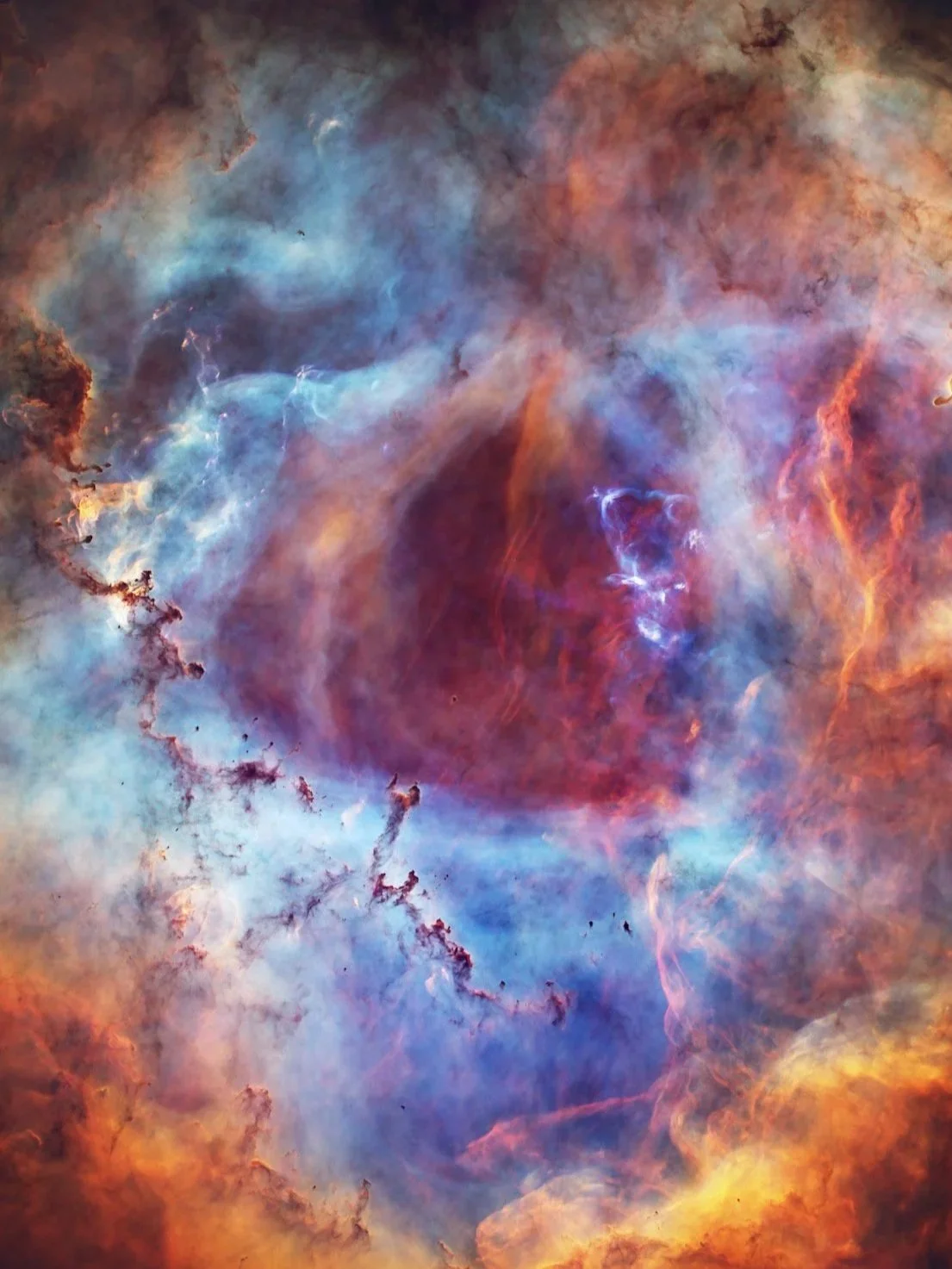
Original Astrophotography By: Rod Prazeres
For the first time since the ‘70s, NASA is sending astronauts to space with the intention of eventually returning to the moon. In many ways, this symbolizes immense human progress. While the initial Apollo mission consisted solely of white, American men, this mission will include the first woman, Black man, and Canadian on any lunar mission. Between the Apollo missions and now, humanity’s knowledge of the cosmos has drastically increased. But in other ways, the return to the moon symbolizes a bleak shift in the world’s space interest.
While many NASA projects suffered from a lack of funding, the moon mission was allowed to continue in part because of a commercial interest in building space tourism centers on the moon’s surface. The newly proposed 2027 United States Spending budget proposes increasing funding for establishing a lunar base camp and phasing governmental projects into commercial endeavors. Simultaneously, it proposes decreasing funding for NASA science efforts, researching space technology, and the International Space Station.
The search for the stars has transitioned from a global dream to a political race, to an international effort, and now, a capitalistic playground.
There is a disconnect happening between the idealized collective message of space exploration as a shared human effort and the rapid transition towards commercializing the space industry. As someone who lives on the Space Coast, my university paused an award ceremony to let us all watch the Artemis 2 launch livestream in a ballroom. My heart swelled with pride, despite the fact that I had absolutely nothing to do with the achievement. We all held our breath until the boosters successfully engaged, erupting into applause when it seemed like the astronauts were safe. I loved seeing people camped out on the lawn, the road signs warning about traffic on roads leading towards the launch, and almost everyone I know posting about it on social media. Similarly, I’ve loved the Project Hail Mary book for years and have adored bringing people to the theatre to experience the heart-warming story for the first time.
In our media and in our reality, people want to experience space as a collective. We want to admire astronauts for their bravery and root for their success. We want space to belong to us— but not just us as a nation. We want it to belong to us as a species and be a tribute to the miraculous feat of humanity’s existence at all.
Strike Out,
Orlando
Written By: Delaney Gunnell
Edited By: Olivia Wagner