Fashion And The Movies
Everybody loves movies. Whether you’re a total film buff or just a casual enjoyer, the film industry has a wide range of movies for everyone to enjoy. For over 100 years now, movies have been an integral part of popular culture; they have made us laugh, cry, and think critically about the world around us. They have reflected us and we have reflected them in return. When you think of what goes into making a movie a few obvious elements probably float to mind: a script, a cast, a director, a camera crew, a set designer, and a producer. However, what might not come immediately to your mind is a costume designer. The clothing of a film is just as integral to storytelling as any other element of film is. Just like the cinematography and score, the costumes of a film express an aspect of the story that cannot be said through dialogue.

Image Courtesy: Instagram
Compared to costume designing for the stage, costume design for film has a relatively short history. According to an article about the early history of fashion in films, costume design in the movies didn’t become significant until The Golden Age of Film, which began around the mid 1910s. The Silent Era, which was the first era of film, was far less focused on costuming as a tool for storytelling. However, as film evolved and expanded into the Golden Age of Film, studios started to realize the power good costuming had in attracting viewers, conveying mood, and developing characters. Adrian Greenburg, widely known as just Adrian, was a prominent costume designer of this era. The article reads, “Adrian understood that costumes should be planned to mirror some definite mood, to be as much a part of the play as the lines or the scenery. In collaboration with the actress, he carefully planned what the clothes should ‘say’ and ‘do.’ He often guided them in how to act ‘with’ the garments.” Adrian understood that the clothing in a film was not merely decoration, but could work as an aid in moving the story forward and in making the viewer feel and understand things that weren’t explicitly said.
As the film industry moved beyond its Golden Age and into the era of modern cinema we are in today, costume design has remained an important element of filmmaking. Just like any other element of a film, sometimes the costume designing of a film is done at a much higher level than it is in others. While costumes may not be the first thing you notice while watching a movie, they can be a fascinating element to analyze, particularly when they are well done. A fairly recent film that I thought had excellent costume design was Poor Things, which was directed by Yorgos Lanthimos and released in 2023. In certain ways, Poor Things is a period piece, as it is set in late Victorian England. However, it is not the late Victorian England we know, but rather an abstract, surrealist version of it. The sets of the film are bizarre, extreme, and dreamlike. Everything we see is an intensified and uncanny version of reality, and the costumes match this stylistic choice perfectly. There are clear influences from the Victorian era in the costuming, but for this film there is no concern for historical accuracy. Rather, Holly Waddington, the film’s costume designer, dresses the characters in extravagant and colorful pieces that seem to make them float in a dreamlike realm. There are familiar elements to them, things we recognize from our own world, but Waddington dramatizes them as much as possible. Poor Things is an excellent example of how style can aid storytelling, as both the set and the costumes in the film are a reflection of the main character, Bella Baxter, and her journey as she matures from having the mind of a small child to that of a woman’s.
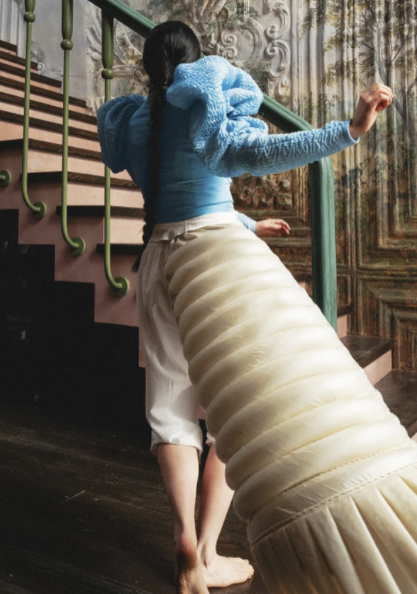
Image Courtesy: Instagram
While Poor Things is a surrealist film and not as concerned with historical accuracy, historical accuracy is another aspect of costume design that can be highly important to a film’s quality. If you are watching a movie set in the 1970s for example, or in 18th century France, you want it to feel like you are actually seeing that period of time depicted. Unless the film has a legitimate purpose in making its costumes or sets feel gimmicky or over the top, you want the costumes of a period piece to feel accurate. Otherwise, the film will feel cheapened. This is another example of the importance of good costume design. It’s not just a part of the film’s stylistic message and storytelling, it can also be a testament to a film’s reliability and accuracy.
I would highly recommend rewatching some of your favorite movies and taking extra notice of the costumes. You may notice things you never have before. We often forget how much attention to detail is put into the movies we love, how every element is being used to express something, however subtle. Costume design is an excellent way to help tell the story of films, and of course to make them prettier to look at!
Strike Out,
Georgia Witt
Editors: Amia King & Kaya O’Rourke
Saint Augustine
Georgia Witt is a blog writer and poet for Strike Magazine, Saint Augustine. She loves reading, writing, fashion, nature, and collecting CDs. She hopes to work in the publishing or journalism field after college. You can reach her at georgiawitt3000@gmail.com.