On Learning Intellectual Loneliness
In my childhood, where conversations often lacked, I talked to myself. In the bathtub, in my bed, on the curb of my street, my voice was my constant sparring partner. I confidently mistook intuition for truth and found great comfort in it. Then I learned that when you actually know something, people will come to you and listen. That year, I became my class president. I began to understand that knowledge is a failsafe connection. This fueled what has been my greatest desire: to be heard. But if you had asked me this question years ago, I would have told you a lie—that all I wanted was to know more.
And yet, here I am, with five times the perspective and less than half of the truth.
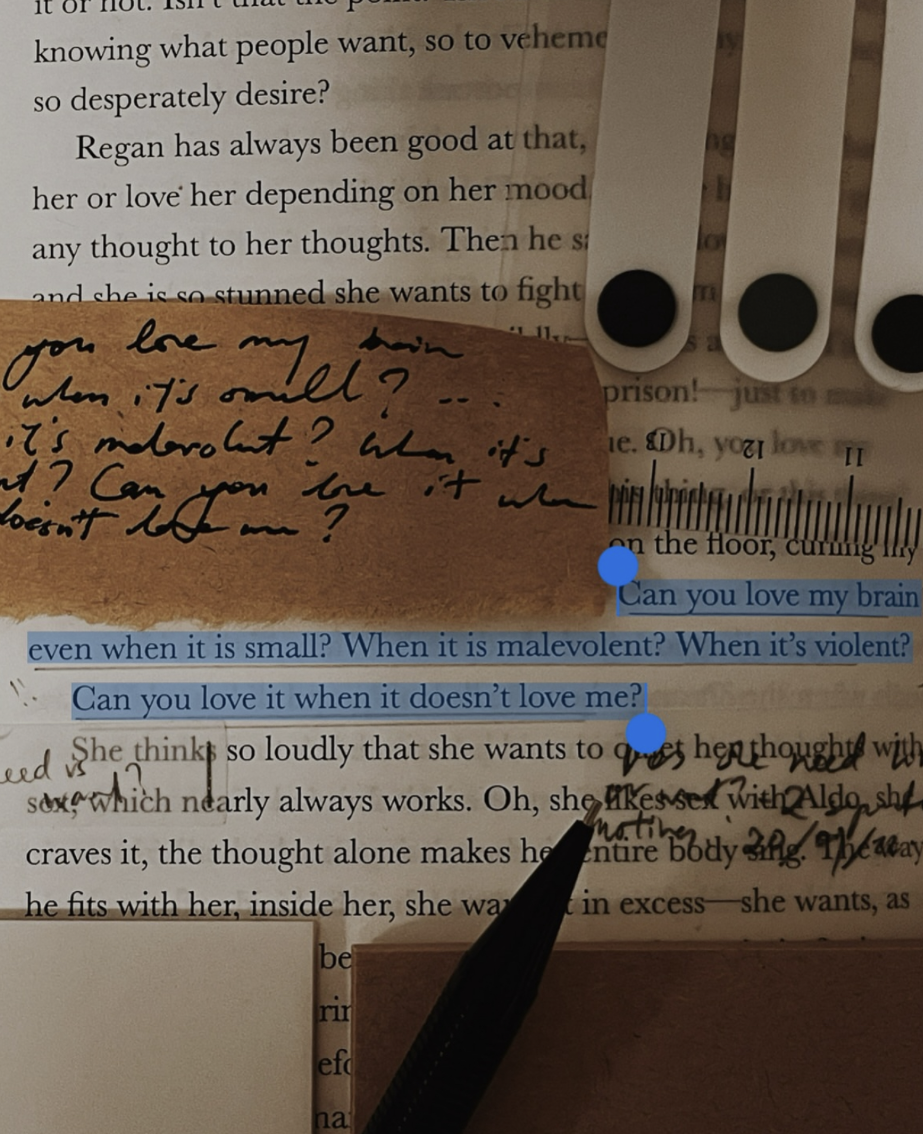
Socrates once said, “The only true wisdom is in knowing you know nothing.” But what does invoking Socrates mean to me? The paradox of digesting perspective—understanding that knowledge expands faster than conviction can keep up. Then choosing between. Because the more you learn, the more you realize how little ground you are actually standing on.
There is trickery in adopting truths as your own. Modern individualism tells us that self-knowledge is the highest form of freedom—that to understand yourself is to become whole. Yet the closer I try to get to myself, the blurrier my reflection becomes. Rousseau believed that truth was found within; Socrates believed wisdom began with admitting that one knows nothing at all. So, between self-assurance and self-doubt, I’ve made a bed—sitting alone again, but now with nothing to say.
The world rewards certainty. It rewards the confident voice, even though we are taught that seeing and believing are not one and the same. The pursuit of knowledge may, in fact, dissolve the self that’s doing the pursuing, especially since intelligence is less about the facts you know and more about the way you approach a subject. I have been told I have no conviction, which might be true, but I believe in overthinking. I believe that there is never one right or wrong answer. This is a conviction in itself, even if it is defined by contradiction.
I always figured I’d find purpose in my own life faster if I could figure out man’s purpose or the human condition through literature and philosophy. It is obvious now that there is no definite truth—but that’s the point. It is clear that the nature of purpose works in reverse. And if knowledge distances me from myself, then experience is the only thing that will define me.
I came across a think piece on Intellectual Loneliness that deeply resonated with my understanding of solitude—
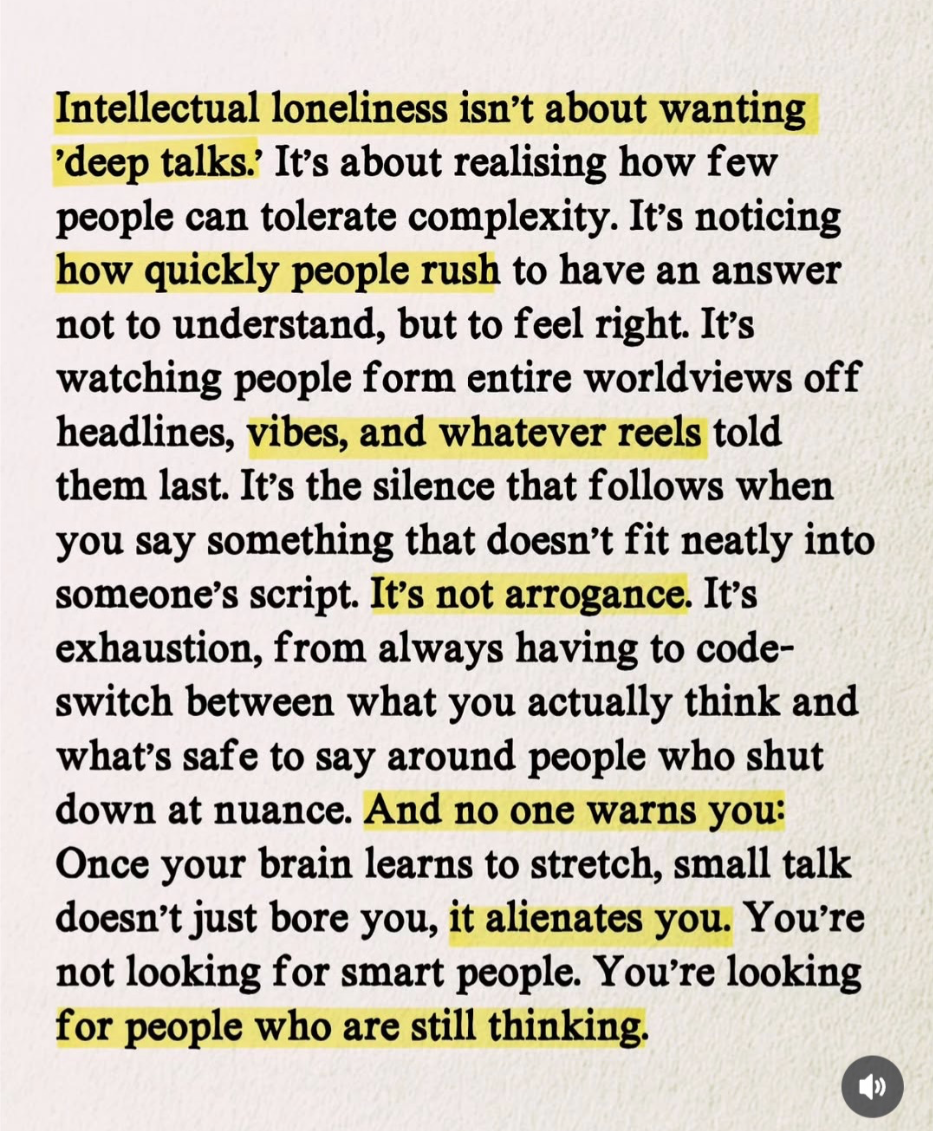
Being an only child kept me inside my head a lot. All I do is think. I hesitate to start conversations, but I crave the stimulation, because individualism does not hold heavy value for me. I am always looking for the bigger picture, always looking for inspiration.
As I mentioned, a small success of mine was a third-grade classroom vote. I highlight it instead of the multitude of my failures, for it is embedded in me to provide proof that I know what I am talking about. But I truly know nothing. And I pray every day that I don’t peak at eight.
At twenty years of age, I can define neuroplasticity and explain how it works within the brain—what it has to do with who you are now and where you came from. But does my recollection of nouns and images reflect who I am or where I came from? I wish I could pinpoint the day I opened my mouth in solitude for the last time. As I longed for someone to listen all this time, it might have silenced me.
Still, I don’t think silence means I’ve stopped searching. Maybe quiet is just another kind of thinking—one that doesn’t need to sound smart to be true. I’m trying to listen again rather than understand, for the small pulse of living that happens when I’m not performing what I know. Maybe that’s all wisdom is—not the collecting of thoughts, but the moment you stop needing to prove them. Because I am thoughtful at my best, people will come to me and listen, because I am deserving of connection. This is all I need to know.
Strike out,
Selah Eve
Editors: Amia King
Saint Augustine
Selah is a content writer for Strike Magazine St. Augustine. Her name, Selah, meaning “pause and reflect,” and Eve, meaning life, reflects how she spends her time. She is a passionate student who loves to travel and meet new people. Check out her Instagram: @selah.eve and her Substack: @selaheve