On Power, Performance, and the First Lady’s Wardrobe
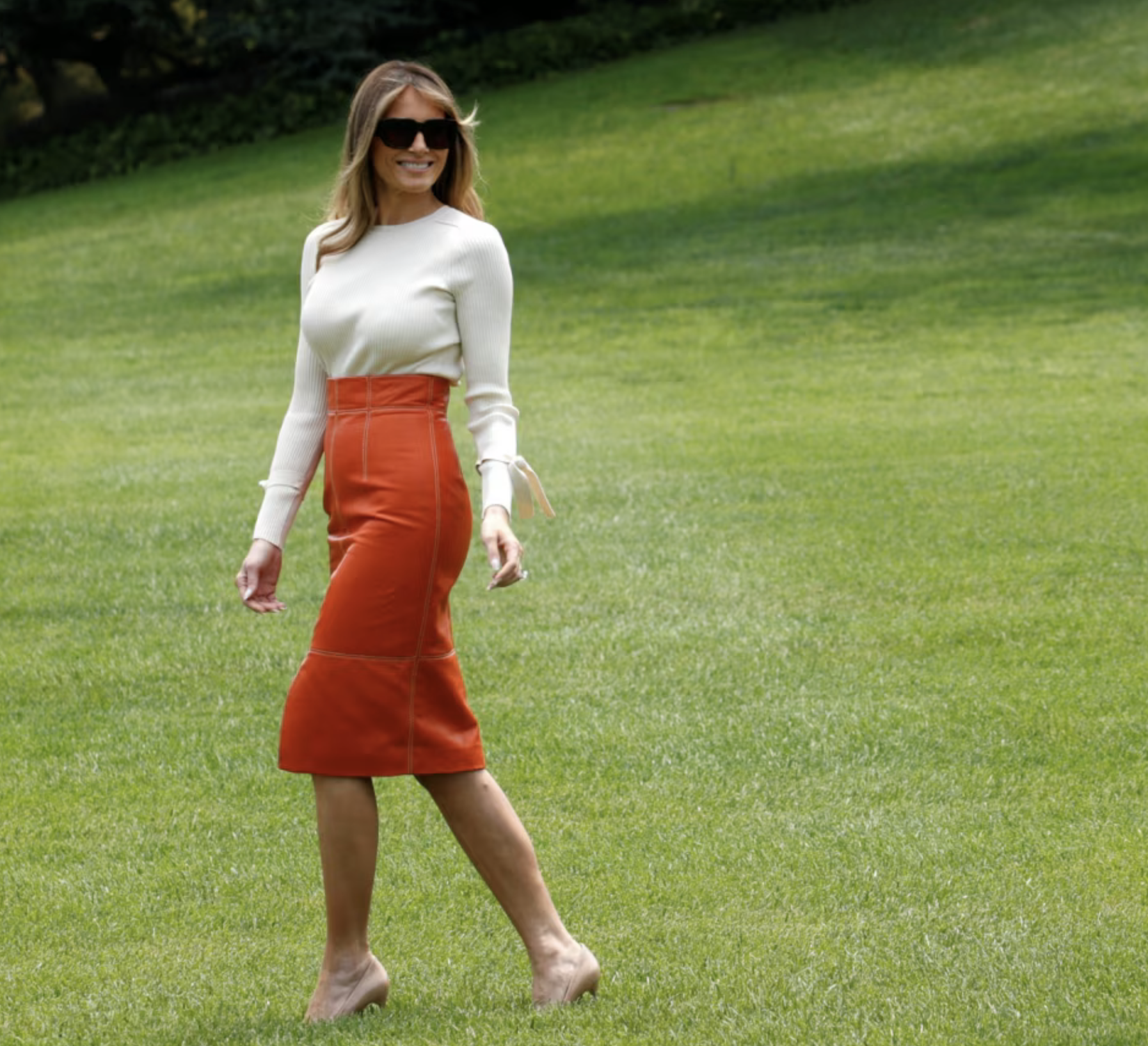
Melania Trump Departing White House | NBC News
It is a commonplace of dress history that clothing is never merely clothing. Long before Roland Barthes proposed that fashion constitutes a system of signs capable of communicating social position, desire, and ideology, philosophers, moralists, aristocrats, and rulers understood that what one wears is a statement of who one is. For the current First Lady of the United States, this logic becomes particularly pronounced. Her wardrobe is simultaneously personal and political, domestic and diplomatic, and therefore subject to constant interpretation.
Few recent First Ladies have generated as much discussion through dress as Melania Trump. A former professional model who rarely granted interviews and delivered relatively few public speeches, she made clothing one of her primary forms of public communication. Her wardrobe can therefore be understood as a deliberate project of identity construction: one that communicated through aesthetic choices, provoked political controversy, and, at times, gained meaning precisely through her refusal to explain it.
The role of First Lady itself places contradictory demands on the women who occupy it. A First Lady is expected to demonstrate patriotism while projecting elegance on the international stage. She must appear accessible, while also representing authority. Melania Trump's approach frequently departed from these conventions, prioritizing her own aesthetic vision over the expectations of the role. This independence became a defining feature of her sartorial identity.
The clearest contrast in this evolution appears when comparing her appearances at the 2017 and 2025 presidential inaugurations.
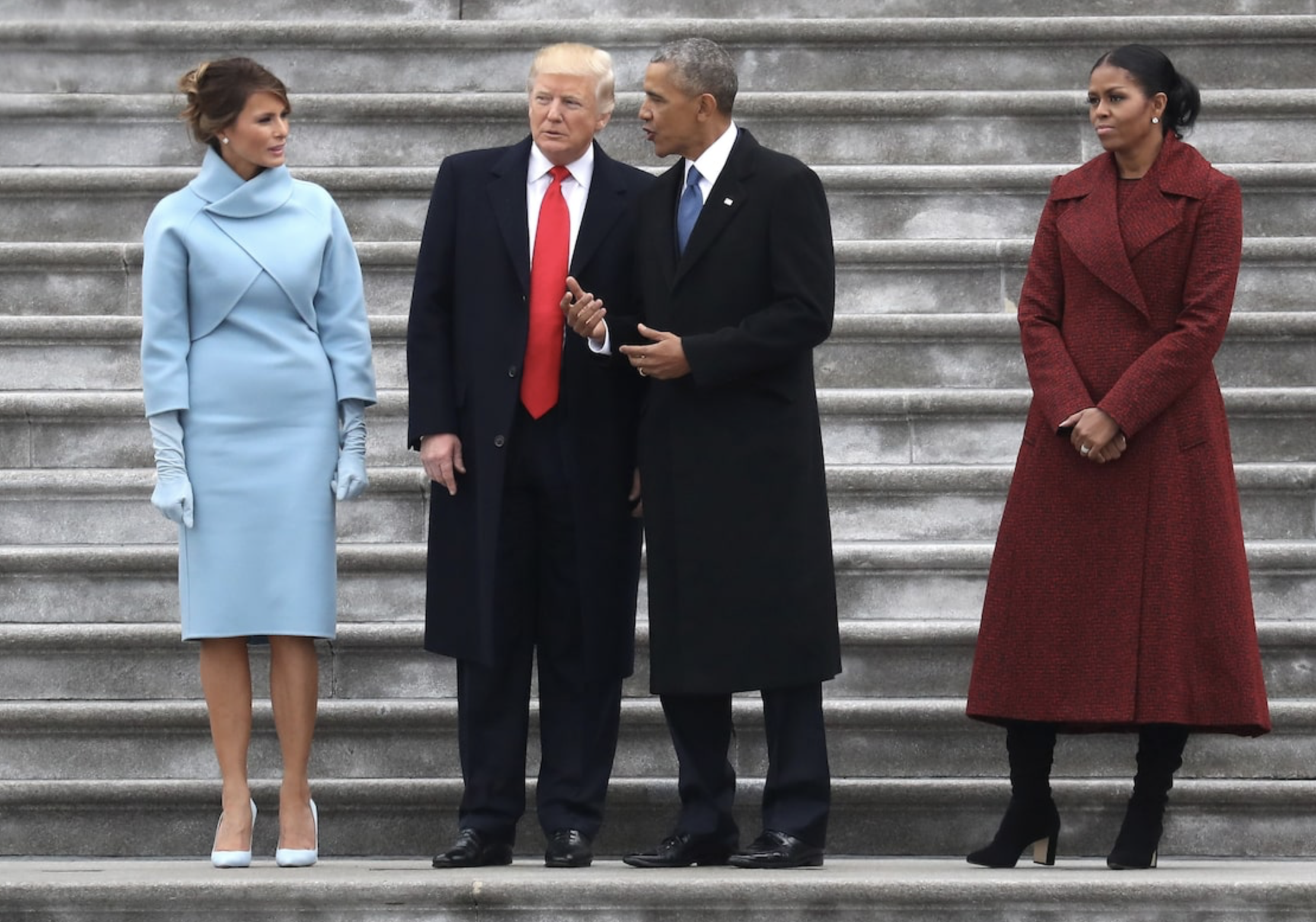
Presidential Inauguration for Donald Trump 2017 | Reuters
At the 2017 inauguration, Trump wore a pale blue Ralph Lauren ensemble consisting of a mock-neck dress, matching gloves, and a fitted silhouette. The outfit immediately invited comparisons to Jacqueline Kennedy's famous powder-blue suit from the 1961 inauguration. By invoking Kennedy, Melania positioned herself within a familiar tradition of First Lady elegance. As an immigrant from Slovenia, the choice also suggested a fluency in the visual language of American political tradition and an assertion that she belonged within it.
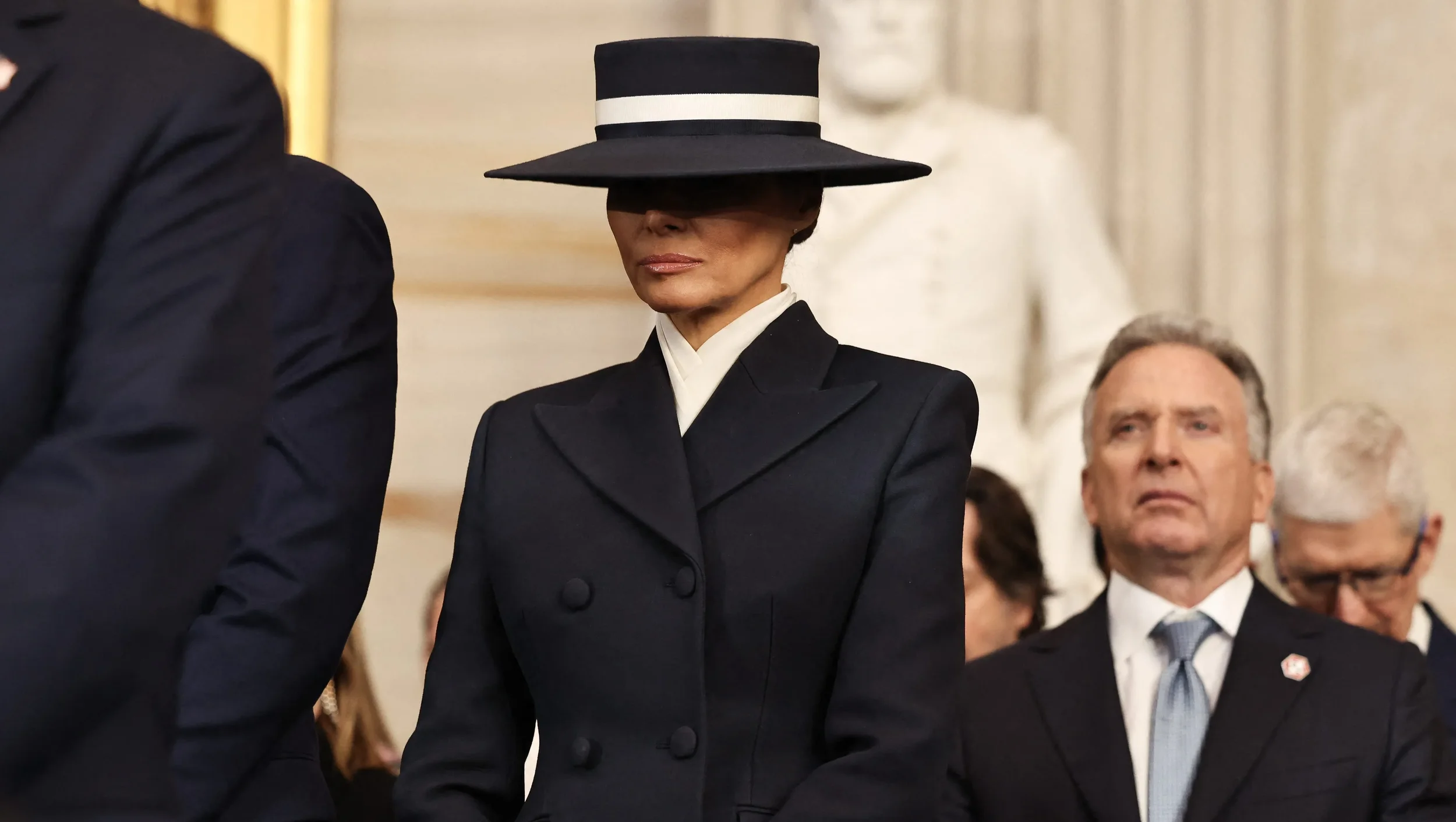
Presidential Inauguration for Donald Trump 2025 | HollywoodLife
Eight years later, her visual language had changed considerably. At the 2025 inauguration, she appeared in a dramatic navy ensemble, including a structured coat, sharp heels, and a wide-brimmed hat that partially concealed her face. The contrast was striking. The pale blue Ralph Lauren look had encouraged comparison and familiarity; the navy ensemble cultivated distance and inscrutability. The hat itself became almost a physical barrier between Melania and the public, obscuring her face and limiting the intimacy normally created through eye contact.
The contrast between the two inaugurations reflects a larger transformation in her public identity. The 2017 wardrobe communicated aspiration and cultural fluency. The 2025 wardrobe projected a more austere form of autonomy. Rather than attempting to embody a recognizable First Lady archetype, she appeared increasingly willing to establish her own visual vocabulary.
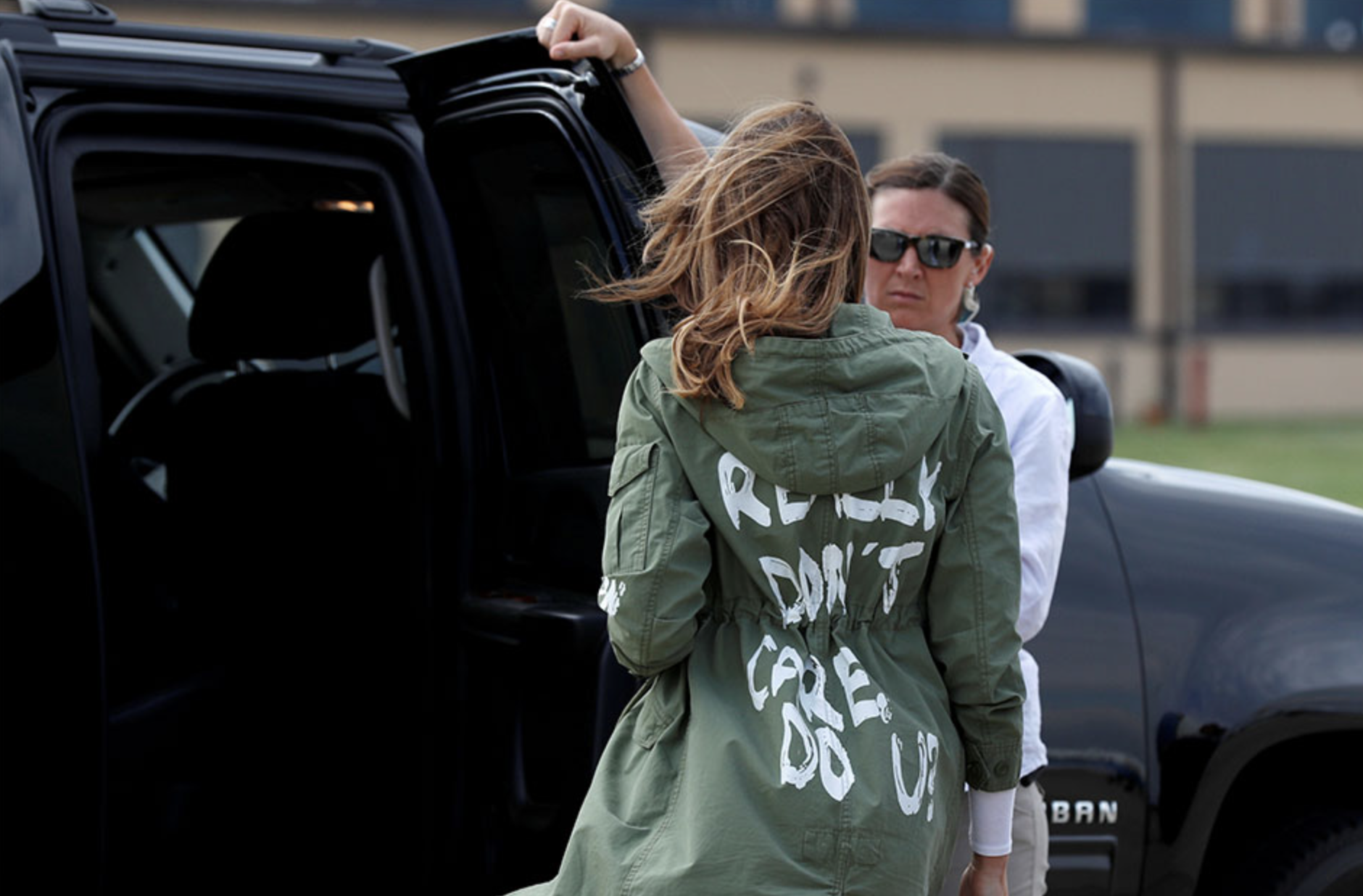
Melania Trump on Migrant Visit | ABCCBN
One of her most memorable examples of that vocabulary emerged through controversy in June 2018, when Melania Trump wore an olive-green Zara jacket while traveling to visit migrant children separated from their parents at the southern border. Printed across the back were the words: "I Really Don't Care, Do U?" The message generated intense criticism, particularly because of the humanitarian circumstances surrounding the visit. Her spokeswoman initially denied that the jacket contained a hidden message, while Donald Trump later suggested that it referred to the media.
The controversy revealed something fundamental about political dress: intention does not entirely determine meaning. Whether the jacket was intended as a political statement or not, its meaning was produced through the context in which it appeared. The contrast between the slogan and Melania's compassionate public remarks during the visit only intensified the ambiguity. Her clothing seemed to speak in a voice distinct from the one she used verbally.
Her relationship with the American fashion industry further complicated this identity. During Donald Trump's first presidency, several prominent American designers publicly declined to dress the First Lady because of their political objections to the administration. Ralph Lauren's decision to design her 2017 inaugural outfit consequently generated its own backlash. Melania increasingly turned toward European luxury houses, including Dolce & Gabbana, Hermès, Valentino, and Gucci.
This preference created an interesting contradiction. The Trump administration promoted an "America First" political identity, while Melania's wardrobe frequently relied on European fashion. Yet she never publicly attempted to resolve this contradiction. Her silence allowed the clothes themselves to become the subject of interpretation.
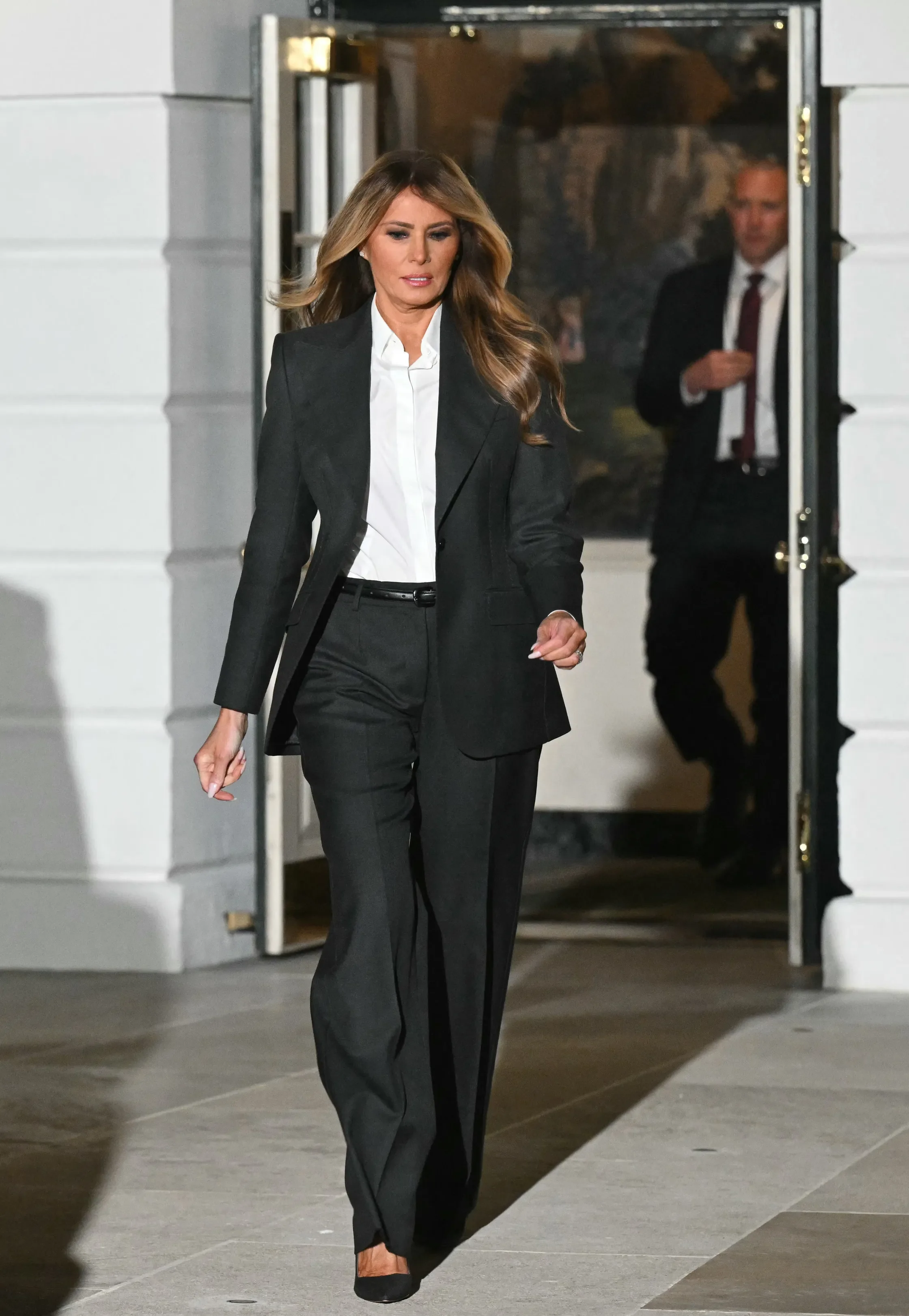
State of the Union 2026 | Vogue
By her second term, another shift became visible: an increased reliance on menswear-inspired tailoring. Tuxedo jackets, sharp silhouettes, and traditionally masculine color palettes created a visual language associated with authority rather than ornamental femininity. In this sense, her clothing increasingly positioned her not simply as the consort of a powerful man, but as a figure asserting an independent form of authority.
Melania Trump's wardrobe demonstrates the extent to which clothing can function as political speech, even when the wearer says very little. Across two inaugurations, diplomatic trips, public appearances, and moments of controversy, her clothing has constructed a remarkably consistent identity: autonomous, aesthetically rigorous, European-inflected, and deliberately difficult to read.
As Lurie argued, dress is a language. For Melania Trump, it has often been the language through which she has been most visible. In the relative absence of words, observers have turned to her clothing for evidence of identity, politics, power, and intention. Whether those interpretations accurately reflect her private thoughts is ultimately unknown. What is clear is that her clothes have repeatedly entered the political conversation and, in doing so, demonstrated that sometimes the most powerful form of public speech is the one that refuses to explain itself.
Strike Out,
Miguel Blas
Miami
Miguel Blas is a writer and photographer whose work lingers somewhere between fashion, desire, nightlife, and the romantic remnants of city life. As a Mathematics and Computer Science student at the University of Miami with a minor in Art History, he brings an analytical mind to work that is often driven by intimacy and visual memory. His writing and photography, including his ongoing project Silhouettes After Sex, explore fleeting encounters, queer intimacy, and the spaces people leave behind after they disappear. After living and working in Paris, Miguel became interested in fashion as both a language of self-invention and a record of the lives lived within it. For Strike Magazine, he hopes to write about Miami through its people, clothes, parties, and quiet moments of romance.
Edited by Samantha Jimenez