Tethered to Womanhood
For centuries women and girls have found self worth through their own vanity, equating their worthiness of life to their level of attraction they inhabited. Still, I find myself and women around me degrading themselves for not being feminine enough.
What beauty is and what it entails has been ever-changing through time and through different cultures. Its origins are varied. In time, women have been urged to be a vessel of attraction–to be sexy, petite, thin, tall–I’ve watched this fester within every woman I know. So many of us base our femininity and connect to womanhood on our physical assets. How enticing can we be to the eye? How can we attain this greater relishing of life that is being the most beautiful one in the room?
There is this subtle estrangement to womanhood if you do not meet the mutating standards created by society. How you dress, your interests, the shoes you wear, the hobbies you’ve acquired- they all tether to womanhood. Although the notion is entirely arguable, the connection is ebbed deep within us, unspoken and buried deeper than we’d like to admit. Even in the most careless of vanity, they are still accompanied by subtleties of the desire to be attractive.
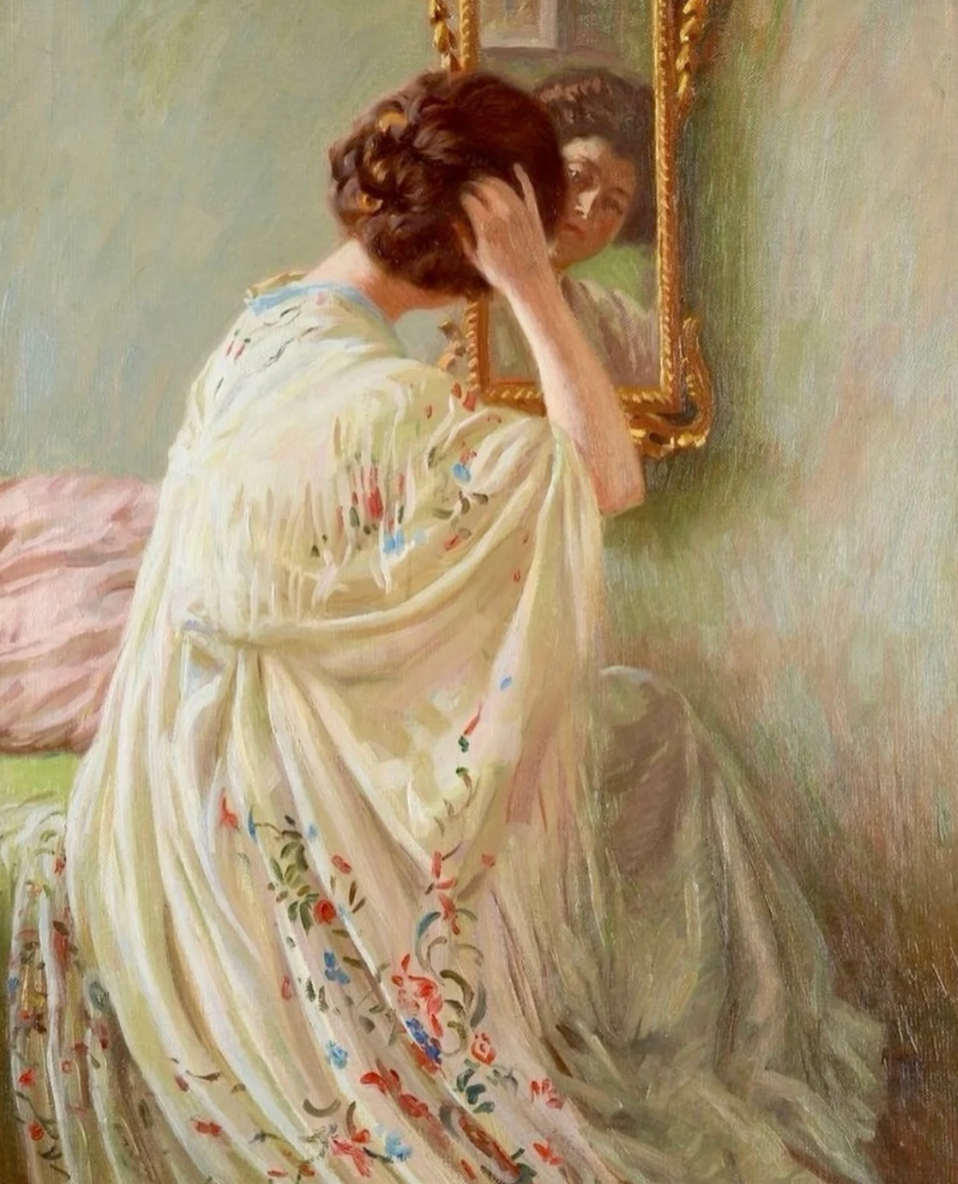
Image Courtesy: Instagram
In my youth and even still, I find this difficulty in feeling feminine enough. I grew up around my mom and two older sisters and yet, I feel this vacancy of girlhood, a narrow fold that I gravitated around instead of through. In my younger teenage years I went through the inevitable discomfort that goes along with the changing body and the awkward, altering face. However, I never quite grew out of feeling self-conscious. I find myself never feeling entirely satisfied with my face. More-so, I find fascination in why it really concerns me at all.
My mom, who is one of the smartest women I know, and who is undoubtedly beautiful, strangely did not feel a disconnect to her womanhood. My mom was born in 1967 in a house of antiquated views on what a woman should be and how she ought to carry herself. Poised, well-mannered, quiet, and modest. My mom presented herself femininely throughout her youth and adolescence, but she also always found herself dirty while adventuring outside. She later went on to study fisheries biology in college, a male-dominated field at the time. I asked her a few days ago if she ever felt a disconnect from womanhood being in such a testosterone-filled environment. To my surprise, she expressed that she never felt that way at all. People made assumptions about her, but she was smart and ambitious and expressed her femininity whole-heartedly. My mother always allowed me and my sister to be unapologetically ourselves. We could be loud, quiet, artists, story-tellers, tomboys, musicians–anything. What she supported most was any of our desires to be as feminine or non-feminine as we pleased. She cared that we were smart and kind. My mom, the same one who would wade through muddy waters and studied slimy organisms, would do it all in her bright outfits and makeup. She often tells me about the pink shoes she’d wear while helping on boats, and I commend her for her vibrancy in being a woman in that field in the 80s.
In our age of media, perhaps that is what’s driving a disconnect between girls and their tethering to womanhood. However, I find it most strange that it is still ablaze in the time of women being as independent as ever. Women were once confined to the small corner that was: you present yourself elegantly as a debutante and hope to gain a husband to give you a life. Now, I wonder how this notion has been transpired into the young women today, who are mostly the superiors of their own lives. Why is wanting to be beautiful in our nature?

Image Courtesy: Instagram
The prejudice against women when they are deemed “unattractive” is beyond disheartening. We are expected to not be vain in our beauty, but to flaunt it as well as it’s what’s desired. It seems society oscillates between acceptance of women and all their forms and reduction of them as people if they don’t meet societal standards. Women themselves mostly encompass their own narratives on what defines femininity. For some it’s their clothing, for others it’s their ambitions–my mom found liberation in her womanhood by pursuing a field not often occupied by women–but womanhood is also dictated by the media, society, and our inner-circles.
Beauty and its backwards tactics have sewn together the idea of livelihood. The more beautiful you are, the more you can expect: jobs, partners, friends, favors. Women have been immortalized as beautiful entities in paintings, sculptures, poetry, photographs. Maybe we are all trying to grasp at the beauty our ancestors carried, and the importance it once enveloped. In reaching for it all, is it thrusting us backwards in time?
Strike Out,
Isa Pullen
Editors: Amia King, Kaya O’Rourke
Saint Augustine