The Beauty of Bambi
If you were like me growing up, you had a lengthy stack of classic Disney films on VHS; a lineup of all the Disney princesses, The Jungle Book, Robin Hood, and more. These classic cartoons have been stamped on the hearts of people young and old around the world, creating a multigenerational impact that has stood the test of time. There is something almost unfair about how beautiful Bambi is, and I don’t just mean that in a stereotypical, nostalgic, Disney way. The film carries this effortless soft visual experience that feels like a watercolor painting comes to life. Every frame, almost breathing, as it is remembered so clearly. The mist rolling through the forest, the way light filters through the leaves, even the silence between bird calls as the film opens. Bambi harnesses the absolute spirit of childhood in nature, which is probably why it hits so hard.
It is clear that there is something exceptional about Disney's animated films during the rise of the Golden Age (1937–1942) and the Silver Age (circa 1950–1967). The 1942 film Bambi—which follows the life of the baby deer we all know and love—changed the trajectory of animation for the entire 20th century. Through the tragic circle of life tale that unfolds, Bambi learns about the beauty and dangers of nature while coming of age as the future prince of the forest.
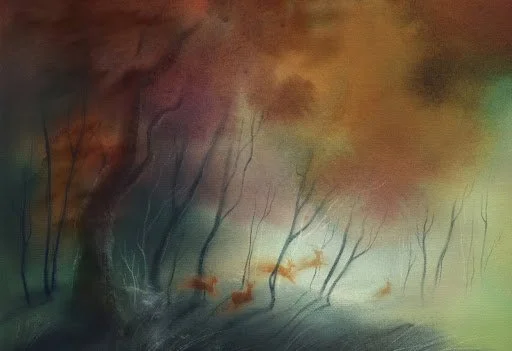
Image Courtesy: Instagram
While the thematics of the story of Bambi are relatively dark, there is a quality to this film that sets it apart from all its predecessors and from many animated films we see today. Long before Bambi debuted, Walt Disney Animation Studios had been quietly constructing the film behind the scenes, starting as early as 1936. The production was massive, involving over a million individual drawings and around 250,000 hand-painted animation cels. This piece was a labor of love in stark comparison to the fast paced production that we commonly see today. The Princess and the Frog (2009) launched Disney into an era that moved away from hand-drawn animation, the princess film being their last fully 2D-animated movie. In regards to the art style of Bambi, much of the film's visual beauty can be credited to the influence and artistry of Tyrus Wong, whose background in Chinese impressionism shaped the film’s distinctive style.
Bambi is a playful world where innocent cartoons meet a somewhat naturalist philosophy. However, the art of drawing animal characters to look “real” and “cute” is a much more difficult task than it seems and it was mastered in this production. I believe that's part of why Bambi took off the way it did, why we remember his face and the faces of all the other characters of the film so vividly. Author Daniel Slack points out, “Cinema and animation do not try to capture reality, they mean to imitate, to interpret it for the means of telling a great story.”
In addition, the Disney Archives claims “The wildlife denizens of Seal Island, Beaver Valley, and Nature’s Half Acre owe their silver screen fame to Bambi. Walt not only brought in live animals to the Disney Studio for the Bambi animators to study, he also assigned artist and photographer Maurice “Jake” Day in 1938 to take photos of the Maine woods throughout the seasons for reference and inspiration.”
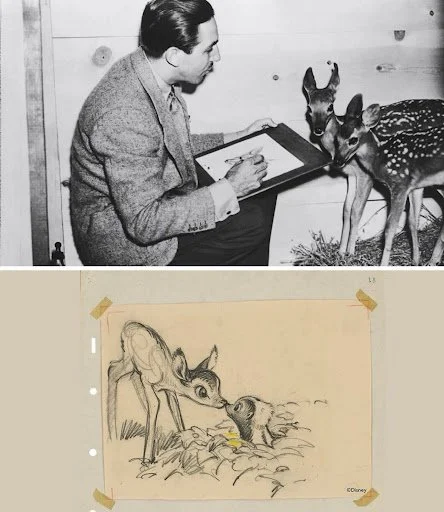
Image Courtesy: Instagram
The art process treats nature not as a backdrop but as a character in itself. The forest grows, shifts, and even gives off the impression of mourning with the characters as the seasons move through the film like moods. Winter isn’t just cold but bleak and beautiful in its loneliness. Spring gives the film a threshold of hope and awkward romance to develop the story further. That subtle layering makes you feel like you’ve lived a whole life in those woods alongside Bambi.
The amount of effort that went into understanding the atmosphere that was being animated is why the film feels so natural and dreamlike. Bambi was actually built on serious observation, thousands of details layered into a seamless whole. The animators weren’t just drawing deer in a forest; they were translating live textures into something that feels alive on screen. It’s why when you watch Bambi, it doesn’t come across as a childish cartoon about animals. It feels like stepping into the woods and remembering what it’s like to pay attention.
Strike out,
Selah Eve
Editors: Amia King, Kaya O’Rourke
Saint Augustine
Selah is a content writer for Strike Magazine St. Augustine. Her very name, Selah, meaning "pause and reflect," and Eve, meaning life applies to how she spends her time. She is a very passionate student who loves to travel and meet new people. Check out her instagram: @selah.eve