
“I’m already so over the guys here,” E said. “You’d think being in college now, there’d be more mature options.”
We all laughed, glancing toward the freshman boys across the room, who were making fools of themselves, dancing and hitting on any girl who crossed their paths. The four of us stood by a set of sticky stools, people-watching and sipping on our watered-down yet simultaneously strong cocktails.
“Are they really that bad already?” S asked sheepishly.
“Oh, you have no idea!” E exclaimed.
K and I exchanged a look but stayed quiet. I hesitated, turning her words over in my head. What if?
“Well, you could always give girls a try,” I said, half-joking. “I like them better anyway.”
For a moment, no one said anything.
“Wait, are you joking?” E asked, turning to look at me.
S let out a polite laugh, seemingly unsure of where the conversation was headed.
“Are you gay?” E asked, her expression suddenly unreadable.
“Yes…”
“ME TOO!”
“Wait, me too,” K chimed in.
The three of us turned toward S, waiting.
“Eeek, I’m straight, but yay, you guys!”
We all burst into laughter.
My first-ever queer friends were women I'd already known for about two months after joining the same sorority. I was ecstatic and finally feeling like a part of something. At that point, I felt like I was a member of some small, secret club. In this stereotypical straight organization, I had somehow found the only two other gay girls.
Only that wasn’t exactly true.
I like to imagine the lull of sorority life through a metaphorical Tiffany lamp. Lit with iridescent stained glass–the only light left on after everyone goes to sleep–small baby moths emerge from all their different corners of the house, some from darker corners than others, and all take flight towards a colorful shine that promises them comfort and warmth.
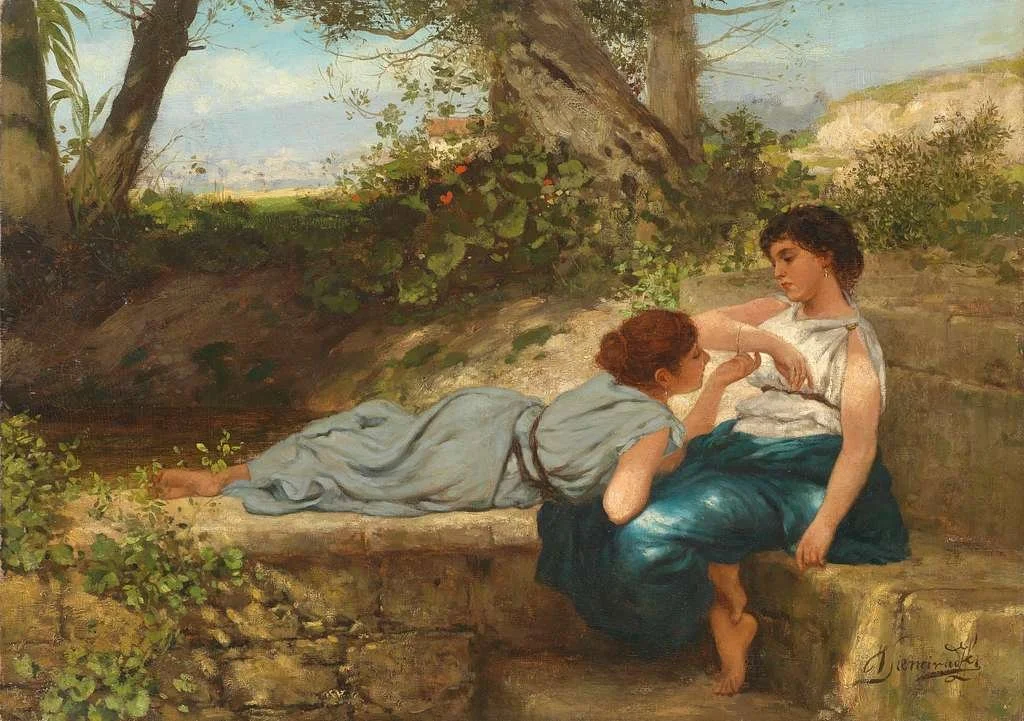
Das Gespräch (The Conversation), Henryk Siemiradzki, 1883. Public domain, via Wikimedia Commons.
Let me back up: “Sorority Rush.” I shudder now at the words that once filled me with thrilling anxiety and excitement. The day I opened my bid, I thought I was walking into one house. I never imagined there was a second one inside it: a smaller room with its own light on, behind a door I didn’t know was there.
I never joined a sorority with the intention of making queer friends. I just wanted friends, period. Everyone knows that when you get to college, you’re looking for your people. It’s about finding the people you click with, people who make you feel like you belong, and that’s so much bigger than whether they’re gay or in a sorority. But a sorority seemed like the easiest place to start. Can you blame me? I got gayer, and not because I was surrounded by women, but because beneath the surface, I was surrounded by gay women–all of us quietly navigating our own complicated relationships with our sexualities.
College finally gave me the opportunity to become someone I hadn’t let myself be in high school: the person I actually was. I was openly bisexual with my friends, but their acceptance often came with fine print: “But you’re still going to marry a man, right?” Comments like these kept me clinging to the closet, its door cracked open, never quite stepping out. I had spent so long trying to fit myself into a shape that was more digestible for the people around me that I convinced myself queerness wasn’t for me, that I was somehow above it all. I barely knew myself yet, so how could I know who I was supposed to love? But college meant a new space, new people, and the chance to stop censoring my feelings. I finally walked out of the closet, even if I was still afraid to leave the bedroom.
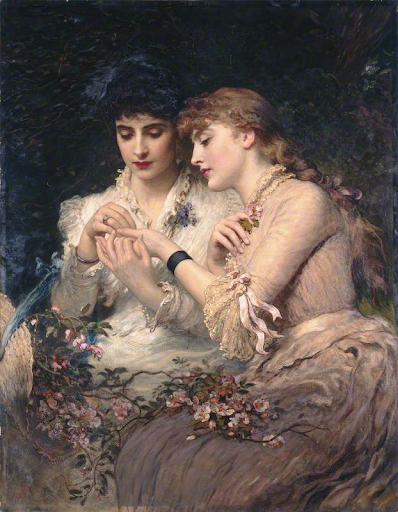
A Thorn Amidst the Roses (1887), James Sant. Manchester Art Gallery. Public domain, via Wikimedia Commons.
My freshman self spent much of her first year censoring that part of herself once again, trying to find the balance between being genuine and fitting in. There were only a handful of openly gay girls and verified allies around whom I felt comfortable being my most authentic self around. With everyone else, I code-switched. I dimmed myself like a lamp with its shade pulled down, giving just enough light to be polite through lunch, sitting with whoever was left. What I didn’t know yet was that the house was full of lamps. Other girls were dimming theirs too, in their rooms, behind other doors, each of us assuming we were the only one still burning. It took time–and a few lucky conversations–to find the rest.
Sororities are old houses, and old houses keep their secrets. You don’t have to dig far into their history to find some of the queer women who helped build them. Queer communities have always existed within Greek life, and quite frankly, I think it’s time we acknowledged them as more than a footnote. No woman should have to shield a part of herself inside a community that claims to embody acceptance.
In my sophomore year, I discovered that my sorority had an LGBTQIA+ chair position, to which I was promptly elected and personally dubbed “gay chair.” I was already out to my friends and the people closest to me, but taking on the role meant that pretty much my entire sorority now knew my sexual orientation. Of course, that didn’t stop the questions. If anything, my new title doubled, maybe even tripled, the number of personal inquiries I received about my gayness.
Eventually, though, I grew to love it. Girls whose names I didn’t even know would introduce themselves, only to slyly slip in, “Hey, so you’re gay chair, right?” toward the end of our conversation. Sometimes, that was followed by the dreaded, “So, how did you know you were gay?” A question from straight girls most of us lesbians are tired of answering, especially when it’s followed up with the inevitable “And you’re sure?” But somewhere along the way, I found pride in being the woman with nothing to hide, a porch light left on for girls who were just looking for a safe place to ask.
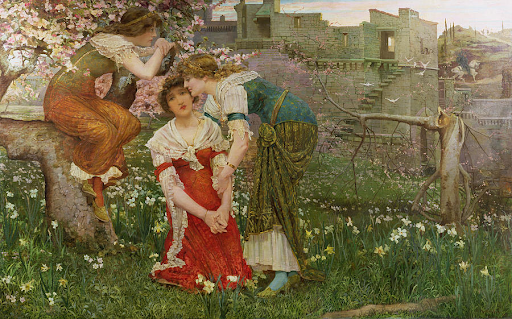
Les trois princesses (1881), Edward Matthew Hale. Guildhall Art Gallery, City of London Corporation. Public domain, via Wikimedia Commons.
Of course, that doesn’t mean homophobia doesn’t exist in Greek life. Believe me, I’ve heard the word “f*g” come out of more girls’ mouths around the lunch table than I’d care to count. But homophobia isn’t exclusive to sororities, and I refused to let it dictate how I showed up in mine. As gay chair, I met ignorance with kindness, normalizing the presence of a sapphic sorority sister just as much as a straight one. I wanted being gay in a sorority to feel less like an exception and more like what it should have been all along: ordinary.
Some of the sorority sentiment still nudged me toward keeping quiet, leftover from an essentially heteronormative stereotype of what a sorority girl is supposed to be. But in my queer little pocket, I found a sanctuary I never expected to find in a space like that: a place for queer self-discovery. Stained glass only glows because it holds more than one color. I had one foot in my sisterhood and one in my queer community, and I never felt pulled between them. The light only came through because I had both.
As finding other queer women became ordinary, the relief that came with it was physical, like unclenching a hand I hadn’t known was in a fist. The women I was growing closer to made me feel understood in ways I hadn’t realized I was missing. I was still calling myself bisexual my freshman year, mostly because it was the word I had. I didn’t know yet that I was still figuring it out.
They say the most important lessons hurt to learn, and mine came with a price: uncovering a queer community inside one that was already so close meant falling for a friend. Queer friendships are known for their blurry lines, but they’ve never met sorority friendships. Back home, I wasn’t someone who hugged my friends without it feeling like a big, tearful occasion. Then I walked into the sorority house, and it felt like the opening scene of Barbie. I was Barbie, greeted with hellos, hugs, and compliments, nothing like what I was used to. If the line between friendly and feminine affection is already that thin, what did that mean for queer friendships inside it? You know your friends love women, you know you always have, and you can’t tell if the woman they love could be you.
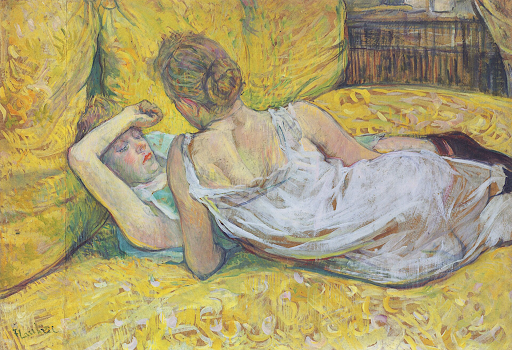
Les Deux Amies (1894), Henri de Toulouse-Lautrec. Public domain artwork.
She was an older girl, supposed to be a mentor and, eventually, a gay mentor too. We bonded over the gay experience, and somewhere in there, friendship started to look like something else. There was the 24/7 texting, the hugs that lasted too long, and the drunk flirting. It was the most confusing relationship I’ve ever had, and one of the first sapphic friendships I’d ever known.
I was a moth, she was the brightest thing in the house, and I flew straight into her. When there’s only one thing you want to look at, of course you’ll stare too long, especially when she stares right back. At the time, losing her felt like being singed alive. I was the one who was openly and confidently out, yet the friendship breakup became the catalyst I needed. For the next few months, I sat with the ache and the realization that, as much as it hurt, I had never felt anything so intense, in the best way possible. I’d spent so long keeping my distance from the flame because I was afraid of getting burned. It turns out a moth that never goes near the light never learns what it’s made of. So yes, my sorority did eventually lead me to realize I was a lesbian.
Before the start of this semester, I left my sorority.
Shit’s expensive.
I am forever grateful, even for the heartbreak. I got everything out of it that I went in for: the friends, the life lessons, the growth, the community. I learned so much about myself, and with the grace and support of the women around me, I stopped dimming.
I still think about that Tiffany lamp, the only light left on after everyone goes to sleep. Somewhere in a house like mine, a girl is sitting in the dark corner where I once sat, sure she’s the only one awake. She isn’t. Stained glass throws its color on everything nearby, whether or not anyone has looked up yet.
Strike out,
Writer: Jayden Weiss
Editor: Reagan Alapa
Copy Editor: Gabriel Gonzalez-Marino
Jayden Weiss is an Editorial Writer for Strike Magazine GNV. You’ll usually find her at her favorite vegan café or strolling through campus, sunglasses on, listening to Clairo, complete with a tote bag on her shoulder. Her photo album is filled with pictures of her friends and the pets of every stranger she encounters. You can reach her by Instagram @jaydenleighweiss or by email at jaydenleighweiss@gmail.com
