“The spiral is a spiritualized circle. In the spiral form, the circle, uncoiled, has ceased to be vicious; it has been set free.” — Vladimir Nabokov
The Fibonacci sequence is a pattern of numbers that unfolds into a spiral in our natural world; seashells, pinecones, the swirl of the galaxy. This recurring motif in life reminds us that growth does not happen linearly. It will loop and curve, double back, but always keep expanding outwards. A spiral itself is how I observe my relationship with solitude. I used to fear being alone, but now I see it as proof that I can carry my own life.
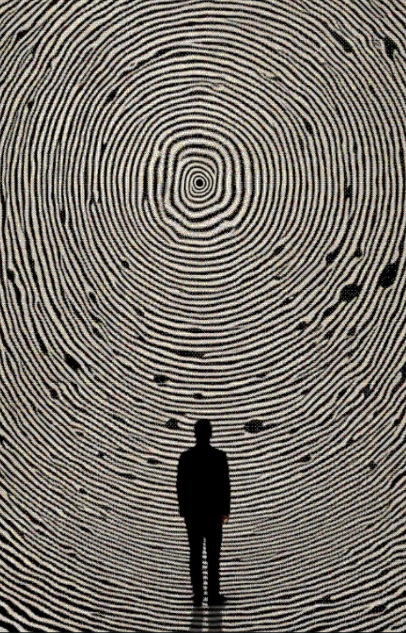
Image Courtesy: Instagram
Recently, I read a telling of the Buddha and how he only found freedom when he stopped seeing his fears and desires as armies out to destroy him, and started recognizing them as brittle, fleeting conditions of the mind. Back in May, I had to escape, turn down the volume, just to hear myself again. I felt like every single notification on my phone was a personal attack on my declining mental health, which led me to change my number. It completely disconnected me from people who I no longer felt needed access to my life.
I have returned to solitude again after trying to grasp onto fleeting energies, but this time I do not feel broken. The spiral has brought me back here, only higher. A large misconception is that loneliness and solitude are the same experience; however they are not.
Loneliness is a void, one that is filled with lust, drugs, alcohol, other people, and so forth. Yet solitude is fullness. You can be surrounded by people and feel lonely, but you can also be entirely alone, and feel whole. That’s the paradox: it is to be so grounded in your own value that you don’t need love to prove you have it within yourself or for others.
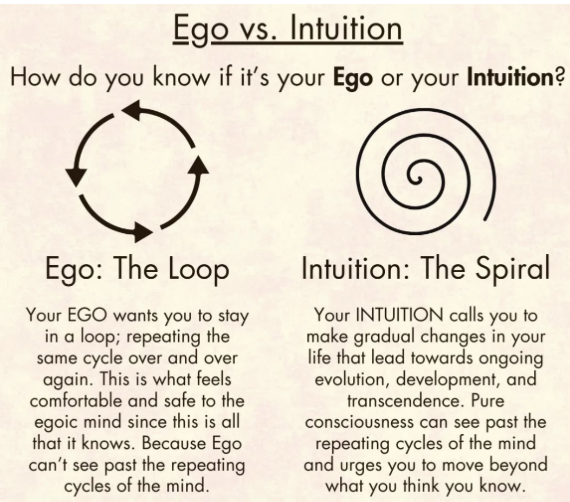
Image Courtesy: Instagram
One of the things that used to haunt me most was the thought of death. When I imagined death, my chest tightened with an aching panic. It was less fear of the end, and more terror of not having truly lived. Lately, it feels like I have slid into a kind of spiritual psychosis, not in a terrifying way, but in a way that’s pulled me deeper into myself. I have spent a lot of time researching Catholic ideas of suffering to better understand the gothic genre. The slow, ritualized attention to loss makes death feel less abstract and more like a presence.
Martin Heidegger calls death the most personal experience there is: if no one can die for you, then no one can live for you either. Though I am not a practicing Catholic, reading into the faith’s attention to mortality and insistence on a fulfilled life has complicated this idea for me. Instead of solitude feeling like pure isolation, Catholic thought has pushed me to see it as a space where life can take shape in the face of death. Taken together, Heidegger and Catholicism have opened my mind to how I measure self-worth and what I most value in life, especially when confronting my own fear of death. In the gothic tradition, figures who failed to face solitude often unraveled into madness and self-destruction. Matthew Lewis’s The Monk is a prime example of how unchecked desire and fear hollow a person out.
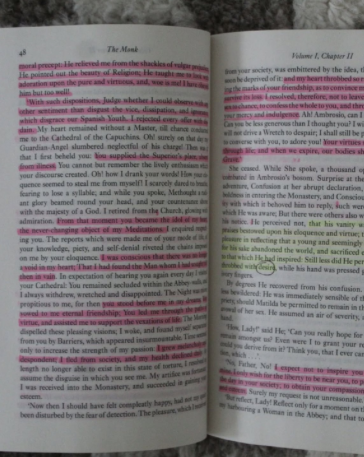
Image Courtesy: Instagram
The Monk’s destruction comes from mistaking dependence for connection, and that is where my own lesson emerges: I have learned that if I am a second thought to someone, why waste any more breath? If you allow people to repeat the past, they will continue to do so. To live authentically is to choose for yourself, to refuse to weigh down others with the weight of your own unlived desires. Solitude, then, no longer feels like absence to me, but like freedom.
This deeper understanding of myself and of the spiral as a shape that recurs has expanded my mind. Spiraling is usually a derogatory term, to say someone is “crashing out” or “spiraling” with anxiety or obsession. But the truth is, a spiral is not collapse but continuation. It always grows outward. You may find yourself circling back to a familiar place, but when you return, you return with more proof of growth.
What feels beautiful to me is that this spiral is not optional. It is part of being human. Yet the choice is whether you acknowledge it. As mentioned, no one can die for you, which means no one can live for you. Your life can only be enduring if you build it around your own true needs. If you keep spinning without learning from each rotation, you end up trapped in repetition—a kind of damnation. If you recognize the spiral for what it is, every loop becomes a chance to expand.
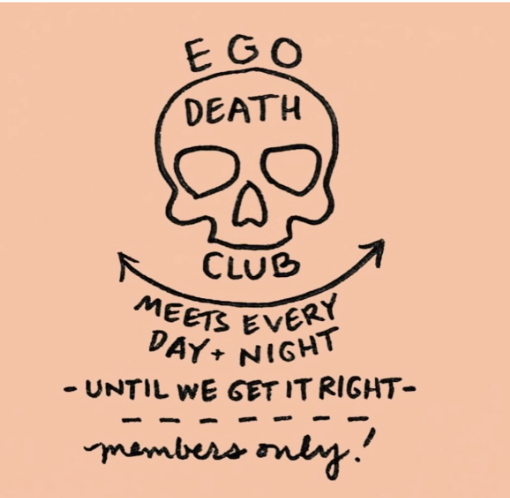
Image Courtesy: Instagram
The clarity I’ve gained from redefining solitude has been life-changing. I am no longer afraid to stand in a room and be fully myself, whether that means laughing too loudly or dyeing my hair whatever color I choose. I no longer depend on the validation of others to sustain me; I am sustainable on my own.
That kind of endurance, that intimacy with one’s own psyche, is one of the most radiant things a person can give themselves. Solitude is not an ending, it is a return, a turning. Each time I circle back to it, I see myself with sharper clarity. What a privilege it is to transform grief and solitude into something sublime.
Strike Out,
Jessica Giraldo
Editors: Amia King, Kaya O'Rourke
Saint Augustine
Jessica Giraldo is the Head Writer of Strike Magazine St. Augustine, as well as a stylist and digital graphic designer. She has been on the writing team since Issue 06, and served as Editor-in-Chief for Issues 08 and 09. Jess tutors high schoolers for the English section of the ACT, as well as middle schoolers in Shakespeare. Her work gravitates towards the Gothic, the Romantic, with a sharp eye for cultural critique.
Reach her @jessicalynnegiraldo@gmail.com