We Need To Talk About Frank O’ Hara.
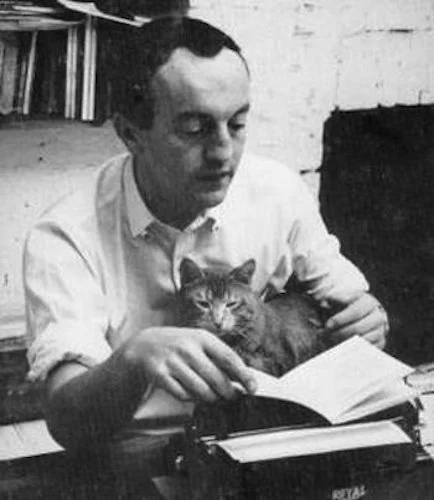
O’Hara with his cat Muffins | Frank O’Hara Residence
I was sixteen years old when I first read Frank O’Hara’s poem “For Grace, After a Party.” I had always liked poetry, but something about that poem in particular moved me in a way I did not even know was possible. I realized poetry was singular in its importance through its ability to cut directly into the soul of the reader. The lines, “it was love for you that set me afire, / and isn’t it odd?” grasp the unusual and distinctive way love overtakes people and keeps them moving through life. Also, the final lines, “and when they arrive they are / just plain scrambled eggs and the warm weather / is holding” shows the reader how ordinary things are made special when seen through the lens of love. Those final lines are what really captivated me the most. It was as if a switch had been flipped and I finally understood that there was beauty in the everyday. Frank O’ Hara showed me what it meant to look at everything with love. My whole world changed in a moment.
There is a specific magic to Frank O’Hara’s poetry that is unwavering and apparent in all of his explorations. Whether you are reading one of his poems about love, or about a party, or about the movies, you will find this sort of electricity of life that he consistently captured. O’Hara’s writing is intimate and conversational. He brings the reader into his daily life with observations of tiny details and feelings never unnoticed. There is a sense of safety to his poetry, as if there is a warm glow surrounding his writing and, by extension, his readers.
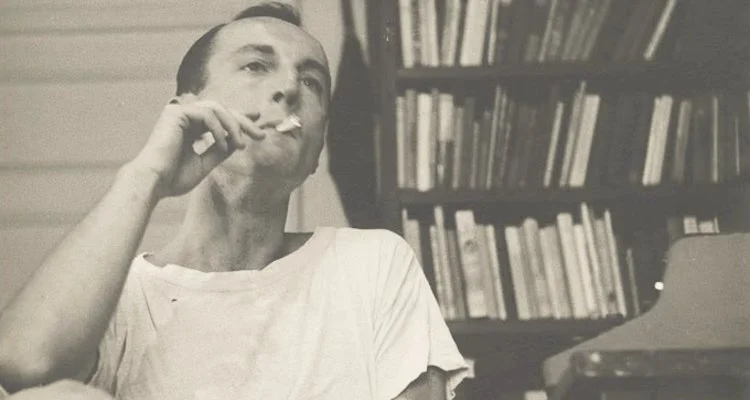
O’Hara Smoking | The Plaid Zebra
Frank O’Hara is monumental. He helped redefine and shape American literature in the 1950s and 60s through his uninhibited writing. He explored topics that were not usually touched upon in poetry, such as the New York art scene. His use of free verse also pulled away from more traditional poetry styles, making space for him to write about non-traditional topics.
In his poetry, it is clear how important art was to him, whether it be music, dance, or paintings. For instance, both “On Seeing Larry Rivers’ Washington Crossing the Delaware at the Museum of Modern Art” and “Why I Am Not a Painter” explore his relationship with paintings and painters.
“On Seeing Larry Rivers’ Washington Crossing the Delaware at the Museum of Modern Art” reveals the role of American culture and history in O’Hara’s poetry. He instantly places the reader into the painting when he describes Washington in the first lines, saying, “Now that our hero has come back to us / in his white pants and we know his nose”. Because of how descriptive he is throughout the poem, the reader feels as if they are brought into the painting itself. His use of words like “our,” “us,” and “we” makes the readers feel united with him and with each other. He does not just simply explain what he is seeing, but rather explains the feelings that come with the painting.
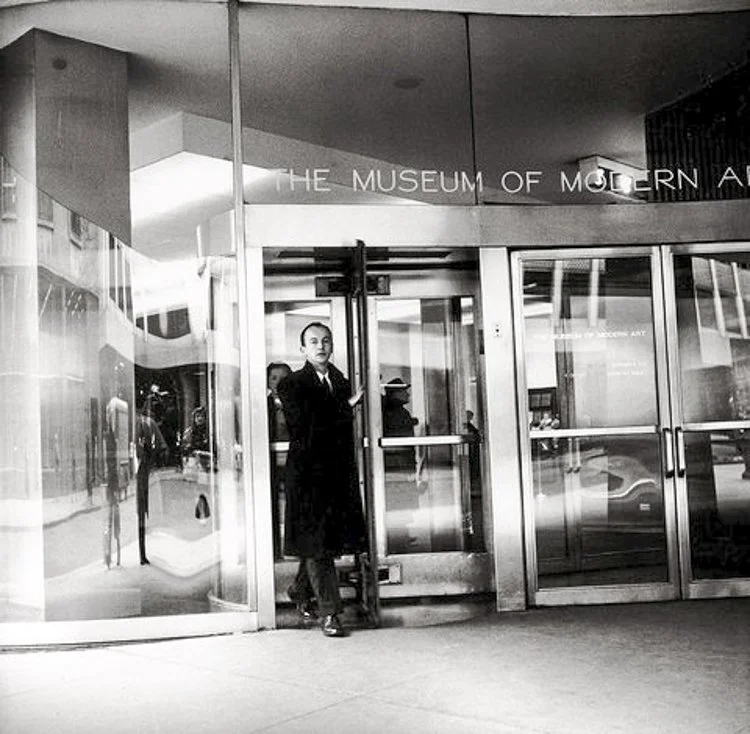
O’Hara at the MoMA | The Plaid Zebra
“Why I Am Not a Painter” has a tongue-in-cheek quality to it. He incorporates conversations with American painter Mike Goldberg, revealing his involvement in the art world. He compares Mike Goldberg’s process as a painter to his own process as a poet to explain why he is not a painter. The reader gains an understanding of O’Hara’s innate need to write with the lines “It is even / prose, I am a real poet.” O’Hara has a remarkable ability to reveal certain truths without having to spoon-feed the reader.
“The Day Lady Died” recounts what O’Hara was doing before finding out jazz singer Billie Holiday had died. This poem, like many others, solidifies O’Hara’s appreciation for music. In classic Frank O’Hara fashion, this poem focuses on the mundanity of everyday life. That is, until he realizes Holiday has passed away. The shift from his usual activities to the moment of realization takes him instantly to a memory of one of her performances. This forces the reader to stop in their tracks beside him. The memory works as a tribute to Holiday. The poem is not sad, but rather a celebration of Holiday’s artistry, as it closes with the lines, “while she whispered a song along the keyboard / to Mal Waldron and everyone and I stopped breathing.” He leaves the reader with the memory of Holiday’s ability to take her audience’s breath away, making it clear that, for him, this was her most striking quality.
In “Having a Coke with You,” Frank O’Hara compares his love of art to his love for a particular person, stating that no matter how beautiful or awe-inspiring a painting might be, it does not measure up to the way he feels when he is with this person. This is one of my favorites of his because it is extremely specific, with lines like “partly because in your orange shirt you look like a better happier St. Sebastian.” Along with its specificity, it is beautifully simple and direct. The lines “I look / at you and I would rather look at you than all the portraits in the world” plays on a constant loop in my mind.
His poetry has a kind of lightness and honesty to it. It takes itself seriously without ever coming off as pretentious or self-righteous. Frank O’Hara was able to capture the essence of the human experience with an attitude of earnest hope and acceptance. His poetry makes the smallest of things seem extraordinarily beautiful, reminding his reader to not let any moment of beauty or love go unnoticed.
Strike Out,
Francesca Rico
Miami
Francesca Rico is a History student at Florida International University. When she is not writing, she enjoys watching movies and finding new cookie recipes to bake for friends and family. She also self-publishes on her Substack, under the handle @chicx5.