Scrolling through TikTok I stumbled upon an edit of Angelina Jolie in a movie—spunky punk hair, lighting a cigarette. Later a scene with Elizabeth Mitchell, calling her the most beautiful woman she had ever seen. Two feminine women in love, naturally, I was intrigued. Yet after watching the film Gia (1998), I felt gutted.
Gia Carangi's story is tragic, she was an icon whose life feels painfully close to home. As a queer woman who loves fashion, I see myself in parts of Carangi’s story. Her queerness was visible in an industry that often erased people like her, as her relationship with Sandy Linter was an anchor throughout her addiction.
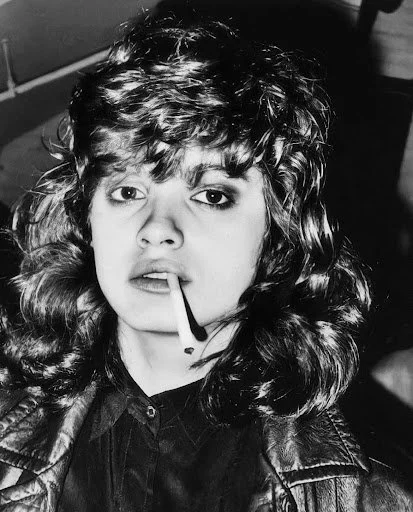
Image Courtesy: Instagram
Carangi was raised in a turbulent environment, witnessing an increasingly violent relationship between her parents, which ultimately led to her mother leaving. By 17, Carangi began getting noticed for her dark features, a striking contrast to the blonde hair and blue eyes dominating modeling at the time. She rose to fame quickly, appearing on the cover of Cosmopolitan Italy at 19. In 1977, she met Maurice Tannenbaum at a gay bar in Center City, a chance encounter that launched her New York modeling career.
Linter met her during a photoshoot, recalling that Carangi “took her feet and threw them over the desk and picked up my punk sunglasses…folded her arms and stared.” This was the beginning of a relationship that was intimate, loving, and formative. Yet, ultimately ended in tragedy.
“Gia and I had a big falling out. It was a famous story about her getting into my apartment through my bedroom window (I live on the 10th floor). That just brought me to my knees, literally, and I thought no, this girl is going to kill herself, I mean I can’t, this isn’t going to happen, and she was not allowed in my apartment anymore.” — Linter
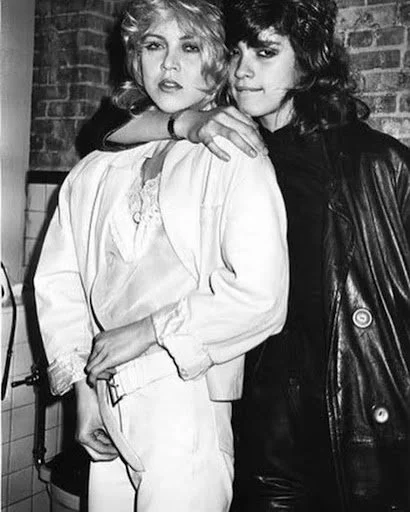
Image Courtesy: Instagram
Carangi’s addiction was likely amplified by the access her fame provided to drugs and money. Her busy schedule had her grace the covers of French, U.S., and British Vogue within just five months in 1979. Her reputation at Studio 54 linked romantically to other women, yet her messy reality was only acceptable to society as long as it was a visual spectacle.
Carangi became the first true supermodel: raw, messy, beautiful, queer, and unapologetic. Her bluntness was a liability, but it made her unforgettable to photographers. It feels like the fashion industry wanted Carangi’s look, but not herself. Her heroin use and vulnerability were transformed into an aesthetic, becoming the precursor to the “heroin chic” aesthetic.
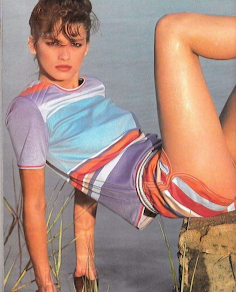
Image Courtesy: Instagram
The November 1980 issue of Vogue magazine featured an image of Gia (shot by Francesco Scavullo) that stirred controversy after people claimed that Gia’s track marks were visible in the image. The fashion spread was titled: “The Start of Something Pretty”.
Watching Carangi’s addiction in the film, and feeling Linter’s pain of witnessing someone lose themselves in real time, sent me down this rabbit hole. Particularly the scene where Carangi breaks into Linter’s apartment where she screams, “You don’t care, you just wanted to say you were fucking a model!” when Linter confronts her with the ultimatum—heroin or their relationship. Carangi holds her, but ultimately leaves with the syringe, leaving Linter in tears. It’s devastating: your love feels dismissed by the person carrying the addiction, and erasure of the tragedy makes it seem as though your care and devotion were worthless.
Linter later recalls seeing Gia just out of rehab: “I was just sitting in my apartment, and when I opened the door there she was, looking how she did when I first met her. I thought she was on the road to recovery. I was so happy for her. Just by seeing her, I was so happy for her. I was just like, this is so… I’m so happy for you, Gia. Go do what you have to do, and we will meet again.”
Two years later, Carangi’s stepdad would call Linter and tell her she died of ammonia, a euphemism used to conceal an AIDS diagnosis. Federal neglect, lack of education, and unsafe drug-use conditions largely contributed to her early death at 26. Despite her influence, her legacy in fashion remains muted; mainstream culture remembers her more as a cautionary tale than a trailblazer.
Her masculine energy, inspired by icons like David Bowie, broke fashion norms: cropped hair, men’s button-ups, distressed jeans, boots, and tanks. She influenced Cindy Crawford, who was called “Baby Gia,” and paved the way for 1990s supermodels. Her work with designers such as Versace, Yves Saint Laurent, Armani, and Levi’s remains iconic, even if her story is under-remembered.
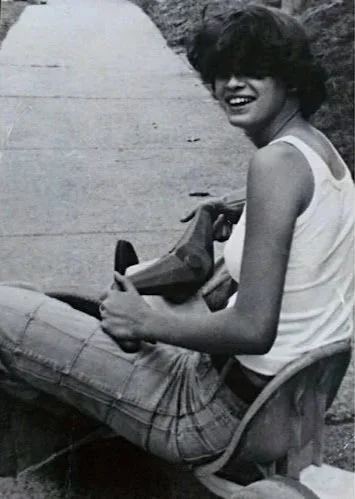
Image Courtesy: Instagram
I want Carangi remembered not just as a tragic figure, but as a cultural icon whose queerness, love, and pain deserve recognition. It is deeply unsettling that the film is categorized as “erotica/romantic”on Google. The depth of her sexuality, addiction, and willpower should never be reduced to titillation. Fashion could love the idea of Carangi, but not the reality. In doing so, it failed her, and everyone who carried love for her.
The industry commodified Carangi’s pain. Her life was transformed into images and stories that could be consumed, photographed, and dramatized. Heroin chic turned suffering into aesthetic; vulnerability was romanticized. Watching the film, seeing glamour and tragedy collide, is like witnessing a world that celebrates her image but dismisses the humanity that loved her.
Strike Out,
Jessica Giraldo
Editors: Amia King
Saint Augustine
Jessica Giraldo is the Head Writer of Strike Magazine St. Augustine, as well as a stylist and digital graphic designer. She has been on the writing team since Issue 06, and served as Editor-in-Chief for Issues 08 and 09. Jess tutors high schoolers for the English section of the ACT, as well as middle schoolers in Shakespeare. Her work gravitates towards the Gothic, the Romantic, with a sharp eye for cultural critique.
Contact: @jessicalynnegiraldo@gmail.com