
Haley Pham is a Symptom, Not the Disease.
Influencer Haley Pham wrote a bad, bad book. The internet hates it. The internet hates her. Almost overnight, her name has become synonymous with slop romance novels and undeserving success. But four years ago, none of that was true. Four years ago, Haley Pham looked at publishing and saw the realization of a lifelong dream. The industry looked back at her (or her subscriber count) and saw dollar signs.
For those of you who don’t know anything about becoming an author, this is how it’s supposed to work:
Step 1: You write a book.
Step 2: You pitch this book to literary agents in the form of a “query” or email. A literary agent’s job is to sell your manuscript to publishers.
Step 3: Because your book is good, you get an agent fairly quickly — let’s say within a year.
Step 4: The agent sells your book to one of the big five publishing houses for a sizable advance.
Step 5: Your book goes through several rounds of copy and line edits. You work closely with several editors who understand you and your unique, creative vision inside-out.
Step 6: The marketing department of whatever publishing house you’re signed to puts a ton of money behind your novel, making it an instant bestseller. Congratulations! You’re a famous author.
When I was 17, I sent hundreds of queries to literary agents, hoping that one would agree to represent me and the terrible novel I had written. It’s hard to explain why I thought this would work. Except, if you were also an aspiring author on TikTok or Instagram in 2024, the idea that a minor could write their way to a major publishing deal wasn’t so far-fetched. I don’t know how to explain it — maybe you just had to be there — but BookTok circa 2024 was truly an unhinged place. Maybe it still is. I wouldn’t know. I’ve since managed to escape. But back then, the platform was flooded with young authors (most of them ages eighteen to twenty) trying to build an audience that would, in turn, attract agents, then publishers. I remember believing so hard that if I just did another round of edits, queried five more agents, posted a TikTok detailing the premise of my story, it would happen for me too. Two years later, I am increasingly glad that it didn’t. As I delved beneath the simplistic, bitter surface of the story that social media wants to tell you about Haley Pham, I saw myself in her. I saw what could have been. I saw a dream and a nightmare so closely intertwined, I almost couldn’t tell which was which.
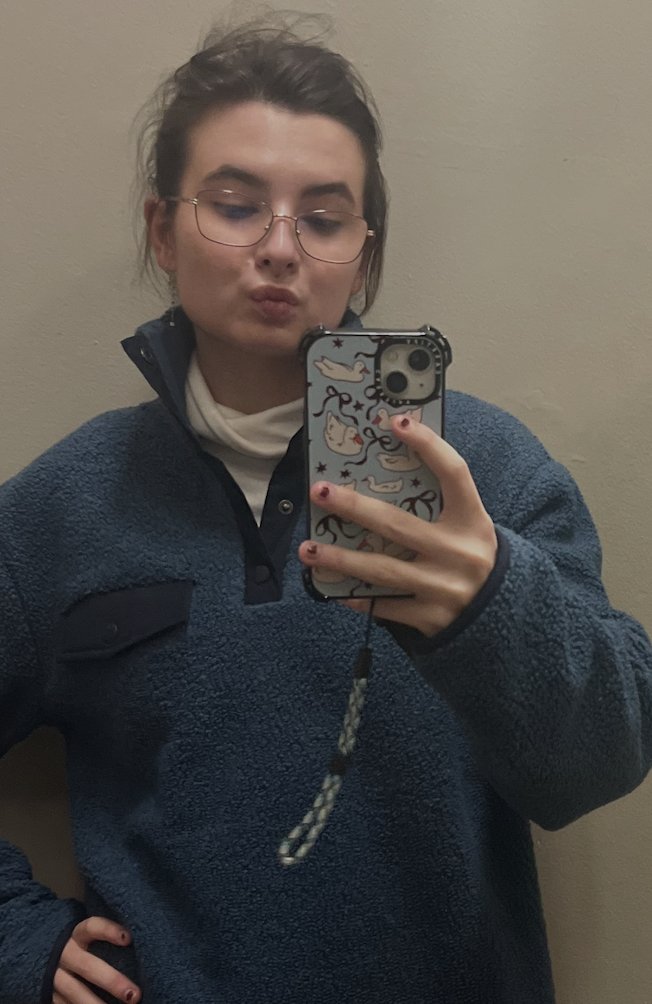
Image Courtesy of Savannah Sisk
17-year-old baby Savannah — so glad nobody gave her a book deal.
We’ve established how publishing is supposed to work. Now, let’s take a look at how Haley Pham became an author. Strap in, because things are about to get weird.
Step 1: You are an influencer.
Step 2: You make a TikTok about how you have decided to write a book. This turns into a TikTok series about writing a novel.
Step 4: You are contacted by a literary agent who offers you representation.
Step 5: You write your book in an extremely short amount of time, likely less than a year. Before it is even finished, your agent has already begun pitching the concept to publishing houses.
Step 6: Banking on the fact that your substantial social media audience will buy the book you write no matter how good or bad it is, a publishing house agrees to sell your novel. Please note that at this time, you have likely not finished draft one.
Step 7: You finish writing your novel. Your agent has an in-house editor who helps you with some edits, but they’re also working with several other clients and likely do not have enough time to give your project the attention that it needs.
Step 8: Thanks to your publisher, your novel goes through one additional round of copy edits.
Step 9: The marketing department of whatever publishing house you’re signed to puts a ton of money behind your novel, but with your built-in audience, the book was already going to be a bestseller. Congratulations. You’re a famous author!
Step 10: Because every single step of this process was rushed, your book isn’t very good. People mock you relentlessly for being a bad writer. On the internet, you are reduced to nothing more than a talentless hack.
“I have to yield to a conglomerate of pedestrians almost every ten feet.”
That’s it. The line that launched a thousand TikToks. Haley Pham's much maligned debut novel "Just Friends" is pretty bad. But that's not necessarily her fault.
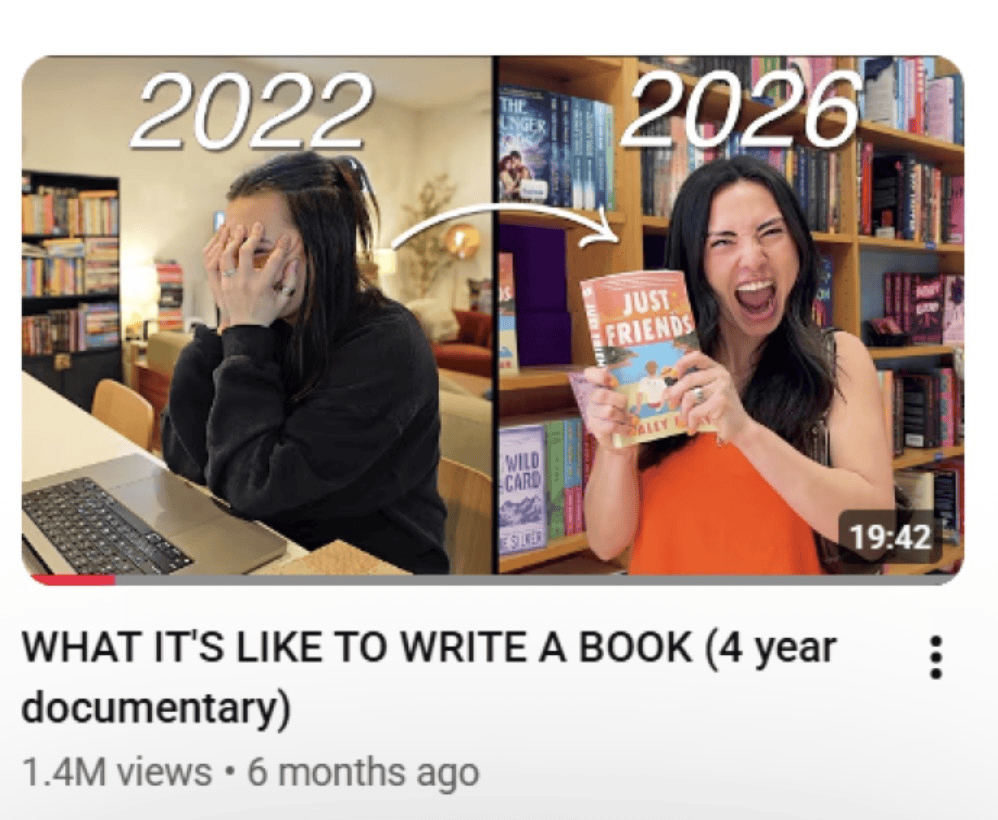
Image Courtesy of Haley Pham on YouTube
On March 4th, 2026, Haley Pham published a “documentary” (vlog, it is a twenty-minute vlog) to her YouTube channel titled: “WHAT IT’S LIKE TO WRITE A BOOK”. The video is informative, to say the least. Before I go any further, I want to make it absolutely clear that I harbor no resentment toward Haley Pham. I think she seems like yet another nice, passionate person who was taken advantage of by an industry. A beacon of success and a cautionary tale. Although Haley never specifies when she was agented or when her book sold to a publisher, the quick pace of her process was almost unnatural. On June 30th, 2024, Haley committed herself to writing the first draft of her novel in two months. That is… insane. For context, Madeline Miller spent ten years writing “The Song of Achilles.” It took Donna Tartt eight years to write “The Secret History.” Writing is a craft, and it takes time. But Haley Pham would write and edit “Just Friends,” her first-ever novel, in under a year.
Haley then reports that she finished writing draft one of her novel in seventeen days. A word count appears onscreen showing that during this time she wrote an alleged 50,163 words. Good for her? Haley then tells us that she printed her finished draft, put it in a drawer, and started editing a month later.
We’re already running into some major problems. Is this a good technique? Yes. I’ve actually done the same exact thing many times before. But once again, Haley’s timing is off. In his book, “On Writing,” Stephen King suggests that authors let their manuscripts rest for six weeks before editing. But Stephen King is famous for churning out novels at breakneck speed. General consensus on forums such as r/writing is that it is a good idea to let your novel “rest” for as long as possible, with some leaving their books to sit for as long as six months. Over the summer, I wrote a 50-page short story that I let “rest” for the same amount of time as Haley Pham did her debut novel.
On March 18th, 2025 (nine months after she began her first draft), Haley tells us that the final draft of her book is due in two weeks. It was then that I began asking questions (yelling at my laptop screen). “Due?! Due to who?! Oh my God. . .” Based on what we’ve seen so far, I’m fairly confident that Haley was agented and had a publishing deal before she actually started writing her book. Why else would it have been due in less than a year? It makes sense that a publisher would be willing to sign her so early on in the process. Her combined 5.49 million subscribers on Instagram and YouTube guaranteed readers, which guaranteed revenue. The only problem? Simon & Schuster didn’t give her enough time to write a good book. We can see proof of this in the vlog Haley posted, proof beyond dates. At this point in the vlog, Haley walks us through what a day of editing looks like for her. And listen. I can’t sit here and tell you that she didn’t work hard. But she is also still editing her book, finding and fixing poorly constructed sentences and plot holes fourteen days before the final draft is due.
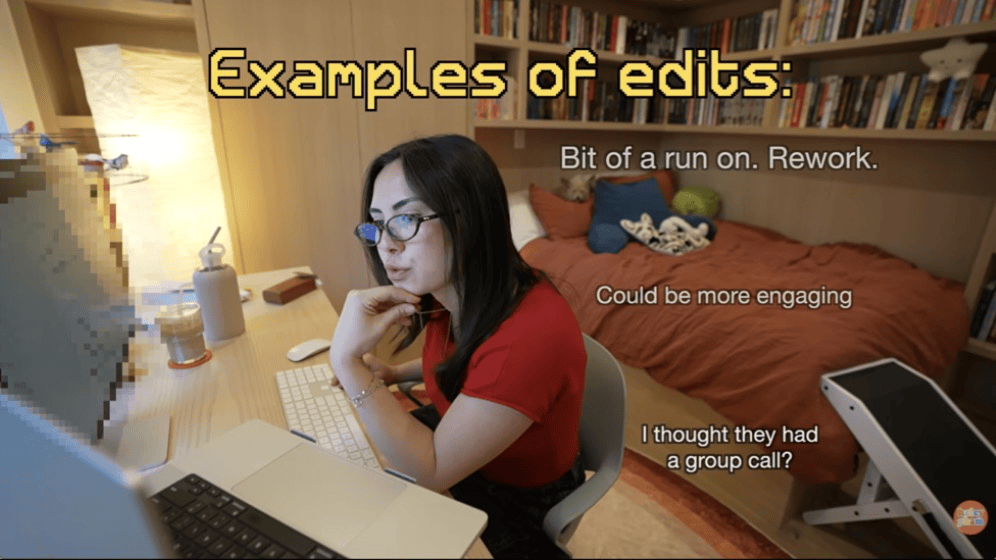
Image Courtesy of Haley Pham on YouTube
Afterward, Haley’s book goes through a single round of copyedits. This is (unfortunately) the industry norm. On August 28th, 2025, ARCs (Advanced Reader Copies) of “Just Friends” were sent out. The point of ARCs is to generate positive reviews from early or “advanced” readers ahead of publication. But at this point, changes to the novel were still being made. This is not the norm. In an update, Haley tells us that immediately after she sent in her final draft, she continued editing unbeknownst to her publisher. These “extra” edits did not make it into the ARC copies but were eventually incorporated into the finished novel. Haley mentions feeling disappointed that none of her ARC readers would be receiving a “finished” copy of her book. During this part of the vlog, she captions a clip demonstrating how she feels about her novel “the acceptance phase.”
By September 9th, 2025, all final edits were done. On March 3rd, 2026, “Just Friends” hit the shelves. Cue the scathing reviews. Cue the evident errors.
“I have to yield to a conglomerate of pedestrians almost every ten feet.”
The amount of derision this single sentence generated was bizarre. But so is its existence. Why didn’t an editor flag this sentence, mocked the world over, as being in desperate need of revision? The answer is that publishing doesn’t have enough editors. The editors they do have are increasingly overworked. And if you’re editing three to five novels at a time, that sentence quickly goes from irksome to passable. A 2026 article by Daniel Frost for PublishingPost, “The Copyeditor Shortage Is Now an Editorial Crisis,” explains that the publishing industry was so intent on perpetual growth at all costs that they fired a ton of editors. Unfortunately for the industry, consumers can tell. Editors who survived the mass layoffs are feeling the strain. When you cut corners, things get sloppy. Poorly constructed yet inoffensive sentences stick around. Excessive em-dashes and ellipses linger. “Book Lovers” become “Just Friends”. Even worse, when the industry fails, writers with large, expectant social followings are caught holding the bag. Haley Pham was set up to fail. She was inexperienced. She was selected because of the revenue a publisher knew her built-in audience would generate. She was barely given enough time to write a book, much less a good one. Wannabe influencers with tiny, Bluetooth-enabled microphones are dogpiling on an easy scapegoat. The deserving culprit is the publishing industry, which has bound writers to unrealistic deadlines and eschewed editors in favor of pumping out content. But, of course, you have to think for longer than five seconds to arrive at that conclusion. And as we all know, thought and time do not lend well to viral TikTok videos.
As of September 10th, “Just Friends” sits at a 3.51-star rating on Goodreads. Despite the fact that the novel has only been out for seven months, it has already been reviewed more than 50,000 times. People call Haley’s writing “middle grade at best” and “reheated Emily Henry nachos.” Things aren’t much better on TikTok. The creator @ilanaslibrary posted a TikTok (now deleted, along with her entire page) harshly criticizing the new release, mocking an old video in which Haley couldn’t remember the word “banal.” In the comments of Ilana’s ensuing apology video, one user wrote, “respectfully haley didn’t even graduate high school… ofc she can’t write a book that’s like coherent & good.”
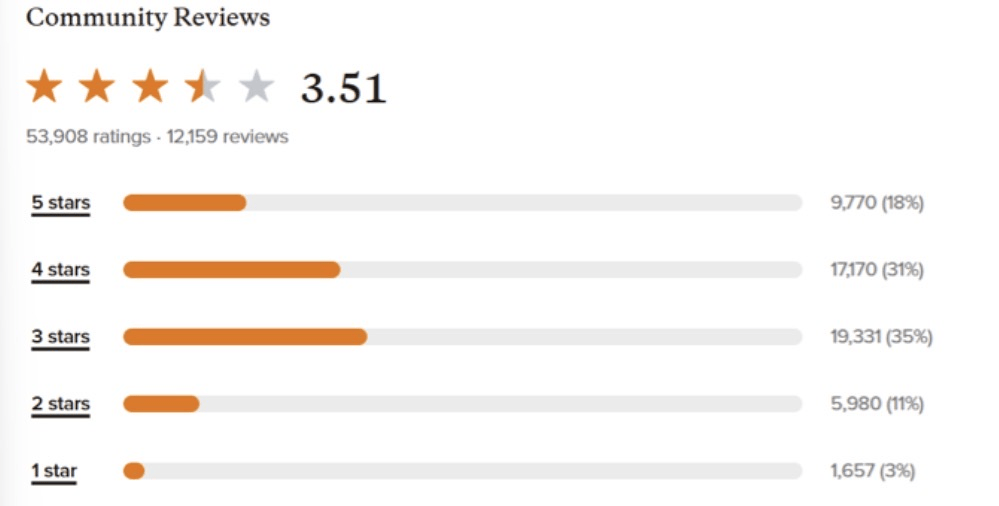
Image Courtesy of Goodreads
Which, like… Come on, people. If you’re going to spew petty hate, then target your spray at Simon & Schuster. Tell them to hire more editors. Tell them to give writers more time. If we’re all going to be vigilante pundits on the internet, we must be more discerning about who, or what, we hate. Because, at this point, I’m getting really sick of watching an internet mob harass a woman while the true culprit —a corporation— slinks off into the shadows, unscathed.
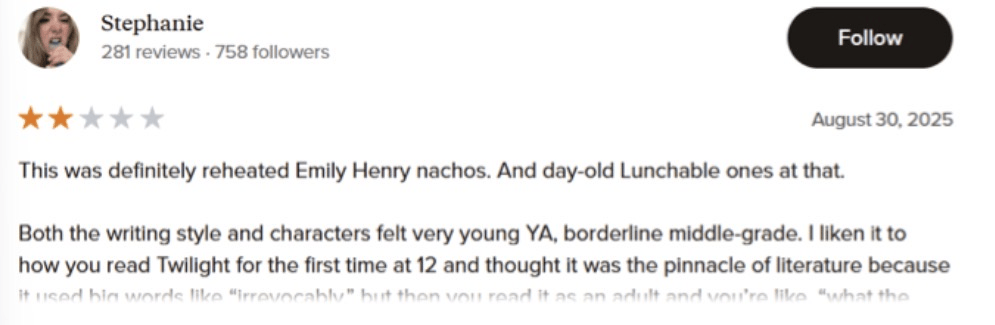
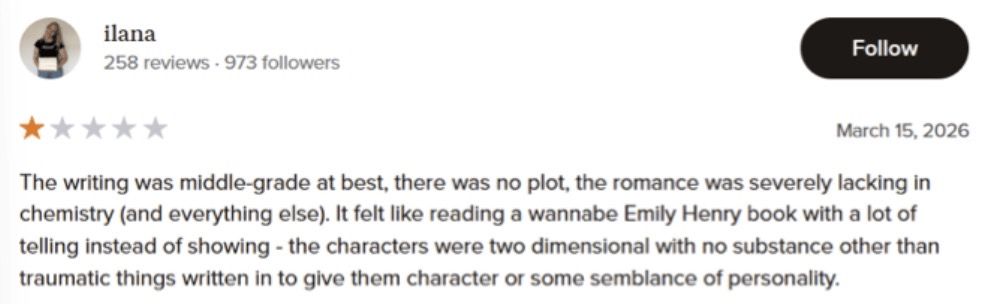
Images Courtesy of Goodreads
On August 8th, 2026, Haley Pham posted a YouTube Short teasing a new book, showing off a hefty stack of freshly printed pages. The top comment? “Genuinely happy that she didn’t let all that negativity stop her from writing.”
Whether Haley Pham has learned anything from her debut remains to be seen. Given how fast she wrote the first draft of her second novel, I have my doubts. But I admire her perseverance. In the photo below, she looks a little shell-shocked. Startled. Maybe I’m reading into this too much. But then again, online hate is no small thing. Most of us still remember the mean things people said to us in middle school. Now, imagine trying to forget the thousands of internet commentators who told you that your writing was trash.
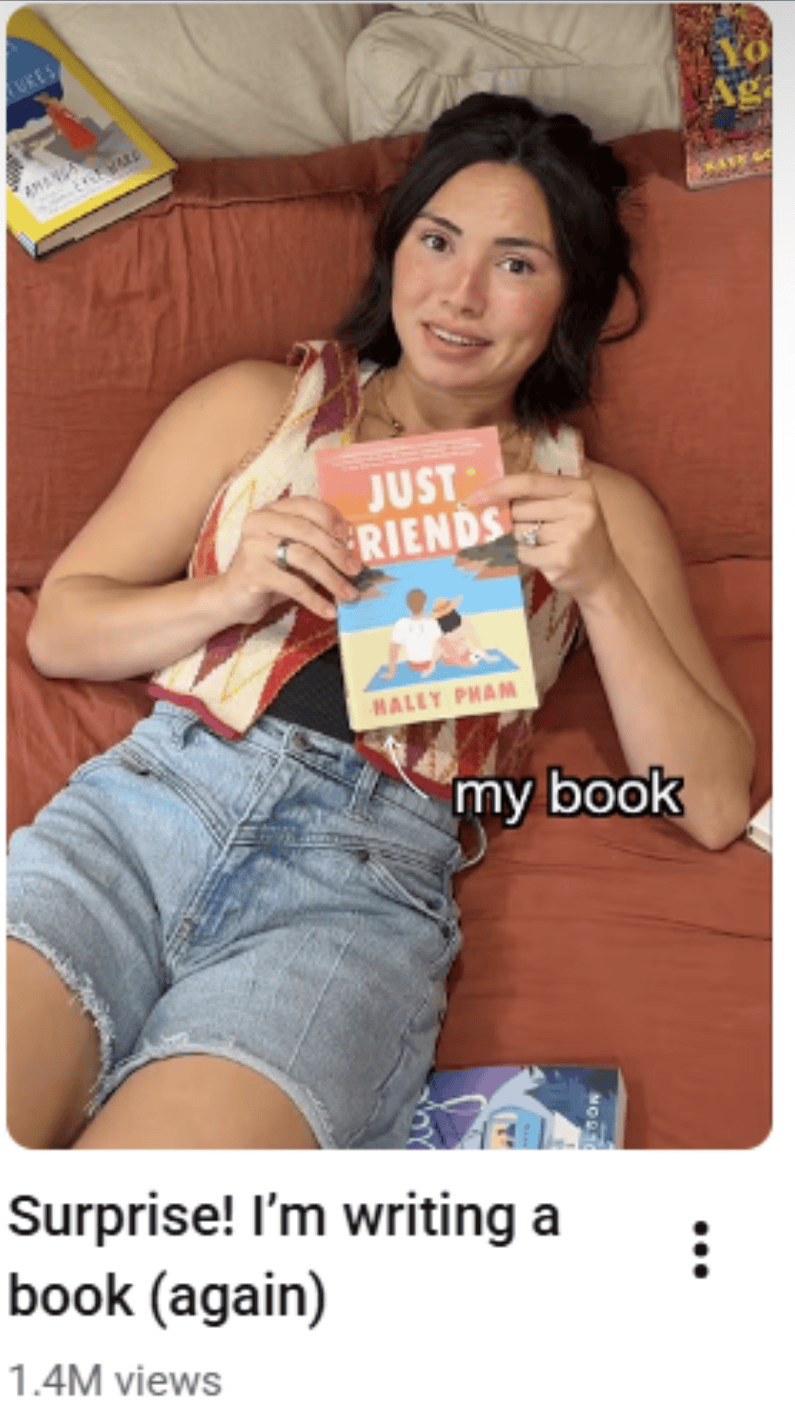
Image Courtesy of Haley Pham on Youtube
Nobody in charge of publishing takes art seriously anymore, and I’m sick of it. Essential jobs are outsourced or eliminated altogether in the name of profit. Editors are overworked. Publishers are careless. False hope proliferates. In terms of both the way it works and the product it produces, publishing is rife with exploitation and disappointment. Haley Pham and her readers are just its latest victims. If this is the cost of perpetual growth, then we must redefine success. Good novels should never be jettisoned in favor of shareholder value.
Strike Out,
Writer: Savannah Sisk
Editor: Camila Turcios Hernandez
Savannah Sisk is a writer for Strike Magazine GNV. She does not enjoy writing about herself in the third person.
